
Hook-First Songwriting: The 0-3 Second TikTok Window (2026)
Hook-first songwriting puts your strongest moment in the first 3 seconds. Song structure, intro length, and skip-rate data for the TikTok window in 2026.
Reviewed by the Chartlex editorial team·Editorial policy
Explore with AI
Get an instant summary of this guide from your favourite assistant.
Quick Answer
Hook-first songwriting means building a track so its most memorable, emotionally loaded moment lands inside the first 3 seconds — the exact window where TikTok autoplay and Spotify previews decide whether a listener stays or scrolls. The data backs the urgency: a study of Billboard's Top 100 from 1986 to 2015 found average song intros shrank from roughly 23 seconds to 5 seconds, a 78% drop (Ohio State University). On Spotify, around 25% of songs are skipped within 5 seconds and roughly a third never reach the 30-second mark. According to Chartlex campaign data from 2,400+ campaigns, tracks with a clear hook before the 7-second mark sustain noticeably lower early skip rates, which protects algorithmic reach. The practical rule: open on the chorus, the strongest lyric, or an instantly identifiable sound — never a slow build.
Why the First 3 Seconds Decide Everything
The clip window is not a marketing afterthought anymore — it shapes the song itself. On TikTok, audio autoplays the moment a video enters the frame, and the average user decides whether to keep watching in well under 3 seconds. If your sound has not hooked them by then, the video scrolls and your track loses its shot at the For You page.
This is the same pressure Spotify applies, just in a different costume. A track that gets skipped in the first few seconds sends a negative signal to the recommendation system. We covered the mechanics in depth in our breakdown of the 30-second rule and Spotify intro skip rate — the short version is that early skips suppress reach before your song ever has a chance to spread.
Hook-first songwriting is the response to both surfaces at once. You are not writing for a 3-minute attention span; you are writing for a 3-second one, and trusting that the rest of the song earns the replay.
The Data: Intros Are Disappearing
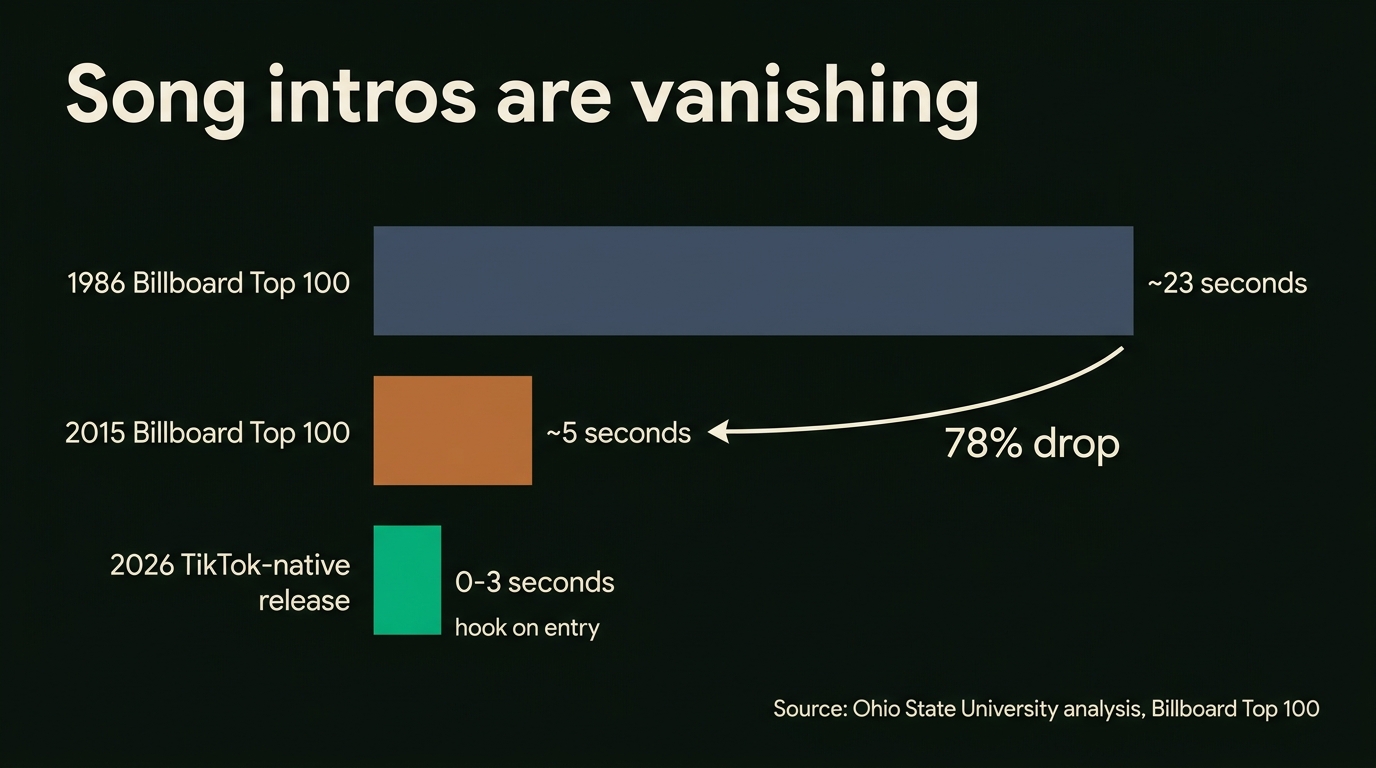
This shift is measurable, not anecdotal. A frequently cited Ohio State University analysis of Billboard's Top 100 charts between 1986 and 2015 found that intros — the time before the first vocal — collapsed from an average of around 23 seconds to about 5 seconds, a roughly 78% reduction. The researcher tied the trend directly to the rise of the skip button: when listeners can bail instantly, artists front-load the parts that keep them.
Streaming skip behavior confirms the stakes. Reporting on Spotify listening data shows roughly 25% of songs are skipped within the first 5 seconds, and about a third never make it past 30 seconds. For an independent artist with no playlist safety net, those early skips are pure lost reach.
| Era / context | Avg intro before vocals | What it signals |
|---|---|---|
| 1986 Billboard Top 100 | ~23 seconds | Radio era, captive listener |
| 2015 Billboard Top 100 | ~5 seconds | Streaming + skip button |
| 2026 TikTok-native release | 0-3 seconds (hook on entry) | Autoplay clip window |
The direction of travel is one-way. Every year the tolerated build-up gets shorter, and TikTok has compressed it further than Spotify ever did.
What "Hook-First" Actually Means
A hook is the single most repeatable, recognizable moment in your song — usually the chorus line, a vocal phrase, or a distinctive sound that a listener could hum after one play. Hook-first songwriting moves that moment to the very top of the arrangement instead of saving it for 45 seconds in.
It does not mean every song becomes a chorus loop. It means the clippable moment — the 8-to-15-second segment a creator would actually use — contains the hook, and ideally the song opens on or near it.
Berklee's analysis of how TikTok is reshaping hit songwriting points to exactly this: artists are restructuring tracks so the engaging parts arrive early and often. Nicky Youre's "Sunroof," for example, opens on the chorus rather than building toward it — chorus, verse, pre-chorus, chorus — putting the payoff first.
If you want the streaming-side complement to this, our guide to getting more Spotify saves in 2026 covers how that early hook converts a passive listen into a save, which is the signal that actually moves the algorithm.
Five Hook-First Song Structures That Work
There is no single correct shape, but five recurring structures consistently win in the clip window. Pick the one that fits your genre and the emotion you are leading with.
| Structure | Order | Best for | Why it works |
|---|---|---|---|
| Cold-open chorus | Chorus → Verse → Chorus | Pop, indie pop | Payoff lands at 0:00 — nothing to skip past |
| Pre-chorus lift | 4-bar lift → Chorus | Dance, electronic | Builds tension fast, resolves inside 8s |
| Acapella tag | Solo vocal line → beat drop | R&B, hip-hop | Voice is instantly recognizable, beat rewards staying |
| Drop-first | Instrumental drop → Verse | EDM, hyperpop | Sound itself is the hook; no lyric needed |
| Question hook | Spoken/sung question → answer | Singer-songwriter | Curiosity gap forces the listener to wait for resolution |
First Push
Never put money behind a track before? First Push is the smallest way to find out how one song responds over about four weeks, and it counts toward anything bigger later.
- ✓About 600 new monthly listeners on one track
- ✓Paced over roughly four weeks, not a single burst
- ✓100% credits toward a bigger campaign within 30 days
- ✓The lowest cost way to try one track
Pick your track here. Credit applies if you upgrade within 30 days.
The common thread: in all five, the clippable moment exists in the first 10-15 seconds and the song gives a creator something obvious to react to, dance to, or finish.
Mapping the clip, not just the song
Before you finalize an arrangement, identify the segment you would seed to creators. If you cannot point to one 10-second stretch that stands alone, the song is not clip-ready yet. This is the same discipline behind sound-seeding campaigns — knowing your hook segment is step one before you ever reach out to creators on TikTok.
A useful test: hum the song to a friend and watch which part they hum back. That part is your real hook, regardless of where it sits in your arrangement. If it lands at 1:30, your structure is fighting your strongest asset. The fix is rarely to write a new hook — it is to move the one you already have to the front and let the verses lead into it rather than away from it.
Emotion is the fastest hook of all
Structure gets you the technical opening, but emotion is what actually stops the scroll. Reporting on viral music posts has noted that a large majority of the most successful music clips lead with an emotional hook — loneliness, joy, defiance, longing — rather than a clever production trick. A plain vocal line that hits one universal feeling in the first 3 seconds will out-travel a busy, impressive intro almost every time. When you map your clip, ask not just "is this catchy?" but "what does this make someone feel instantly?"
How to Engineer the Hook Into Your Writing Process
You do not need to be a producer to apply this. Work backward from the clip.
- Write the hook first. Start the session with the line or sound you want people to remember. Build the rest of the song around defending that moment.
- Cut the runway. If your demo has more than 3-4 seconds before something memorable happens, trim it. A 4-bar atmospheric intro is a 4-bar invitation to scroll.
- Test the 3-second start. Play only the first 3 seconds to someone who has never heard the track. If they cannot tell you what the song "is" from that, the hook is buried.
- Make one segment loopable. TikTok creators reuse the same 8-15 seconds thousands of times. Design at least one segment that sounds complete on repeat.
- Match the hook to an action. Viral sounds tend to suggest something — a dance move, a transition, a punchline, an emotion. Tate McRae's "greedy" and Sabrina Carpenter's "Espresso" both built rhythmic hooks that handed creators an obvious thing to do.
Once the song is built this way, distribution is a multiplier rather than a rescue mission. For the platform-side playbook on actually pushing the finished track, see our guide to using TikTok for music promotion in 2026.
Where Streaming and TikTok Reward the Same Move
The reason hook-first writing is so efficient is that it pays off on both platforms with one decision. A track engineered for the TikTok window also happens to have the low early-skip profile Spotify's algorithm favors.
According to Chartlex campaign data from 2,400+ campaigns, tracks that lead with a clear hook before the 7-second mark hold lower first-30-second skip rates than slow-building tracks — and skip rate is one of the strongest negative signals in the system. Spotify's own algorithm benchmarks treat a first-30-second skip rate above 35% as a reach suppressor.
Before you commit a release date, it is worth pressure-testing this against your full launch plan. Our Spotify release strategy gameplan walks through sequencing the song, the clip, and the promotion so the hook lands while the algorithm is still paying attention.
And if you are weighing what a campaign behind a hook-first track is actually worth, plug your numbers into the Spotify royalty calculator to see the real per-stream math before you spend on promotion.
Common Mistakes That Kill the Hook
- Treating the intro as warm-up. A 12-second instrumental build feels cinematic in the studio and reads as dead air on autoplay.
- Hiding the hook in the bridge. If the best moment is at 2:10, almost no one hears it.
- Over-producing the open. A cluttered first 3 seconds is as bad as a slow one — the ear needs one clear thing to latch onto.
- Writing the clip after the song. Retrofitting a hook onto a finished track rarely works. Build clip-first.
- Ignoring the skip data. If your release history shows high early skip rates, the structure is the problem, not the promotion.
Free Spotify Audit
See exactly where your Spotify profile is leaking growth.
Most artists leave 3–5 editorial playlist slots on the table — find out if you're one of them.
Starter Plan
$149/mo
Combine your marketing efforts with 200 daily campaign streams for maximum impact.
Verified in Spotify for Artists · Geo-targeted · Cancel anytime
To see exactly where your current catalog is losing listeners, a free AI audit from Chartlex breaks down your skip and save signals so you know whether your hooks are landing before you write the next one.
Frequently Asked Questions
What is hook-first songwriting?
Hook-first songwriting is structuring a track so its most memorable moment — the chorus, a vocal phrase, or a signature sound — lands in the first few seconds rather than after a long build. It is a direct response to TikTok autoplay and Spotify skip behavior, where listeners decide to stay or leave almost instantly.
How long should a song intro be in 2026?
Aim for 0-3 seconds before something memorable happens. A study of Billboard hits found intros shrank from about 23 seconds in 1986 to roughly 5 seconds by 2015, and TikTok-native releases now often open directly on the hook with effectively no instrumental runway at all.
Does leading with the hook hurt my song artistically?
Not necessarily. Leading with the hook is a structural choice, not a quality compromise — many acclaimed releases open on the chorus or a strong vocal tag. The craft is in making the rest of the song reward the listener who stays, so the early hook earns replays rather than feeling like a gimmick.
How does the hook affect my Spotify skip rate?
A clear early hook keeps listeners past the first few seconds, which lowers your skip rate. That matters because Spotify treats high early skip rates as a negative signal — benchmarks flag a first-30-second skip rate above 35% as something that suppresses algorithmic reach and playlist consideration.
Which song structure is best for going viral on TikTok?
There is no single best structure, but cold-open choruses, pre-chorus lifts, and drop-first arrangements all tend to perform well because they place the clippable moment in the first 10-15 seconds. The key is ensuring one standalone segment sounds complete on loop and gives creators an obvious reason to react.
Write for the Window, Not the Album
The artists winning the clip window in 2026 are not necessarily the best songwriters — they are the ones who put their best 3 seconds first and trusted the rest to follow. Intros are not coming back, and the platforms that decide your reach reward the same hook-first instinct.
Build the hook first, cut the runway, and make sure one segment stands alone. Then check your data before you write the next track — a free Chartlex audit shows whether your hooks are actually holding listeners, and the TikTok promotion playbook covers how to put the finished clip in front of the right creators.
Free Weekly Playbook
One actionable insight, every Tuesday.
Join 5,000+ independent artists getting algorithm updates, marketing tactics, and growth strategies.
No spam. Unsubscribe anytime.
Discover the exact campaigns that will convert your fans.
Most artists guess at what works. Audit users know.
Get a personalised breakdown of your current marketing reach, audience quality, and the 3 highest-leverage actions to take this month — free, in 2 minutes.
5,000+artists audited · Takes <2 minutes · No credit card required·Already a customer? Open Dashboard →
Campaign Dashboard
Turn Knowledge Into Action
Track your streams, monitor algorithmic triggers, and see growth projections in real time. The Campaign Dashboard puts everything you just read into practice.
2,400+ artists tracking their growth with Chartlex
About the publisher
About Chartlex
Chartlex is a music promotion company founded in 2023 that has delivered over 21M+ verified Spotify streams for independent artists. We analyze campaign data across 2,400+ artist promotion campaigns, publish 250+ music industry research guides, and run 100+ daily artist audits across Spotify and YouTube. Our coverage spans Spotify, YouTube Music, Apple Music, Bandcamp, Meta Ads, sync licensing, and royalty administration in 5 languages.
- Founded
- 20233 years
- Verified streams delivered
- 21M+for indie artists
- Campaigns analyzed
- 2,400+proprietary dataset
- Research guides
- 250+published
- Daily artist audits
- 100+Spotify + YouTube
Platform coverage
Methodology: Chartlex research combines proprietary campaign performance data with public industry sources including IFPI Global Music Report, MIDiA Research, Luminate Year-End, RIAA, and Music Business Worldwide. All findings are refreshed quarterly. Last verified: 2026-09-17.
Keep reading
TikTok sound seeding step-by-step: how to seed your audio to 20-40 nano creators, what rates to expect, and how to measure the real stream lift in 2026.
Lena Kova
Stop using #music with 500M posts. Here is the exact hashtag strategy for Instagram Reels and TikTok that gets independent artists discovered in 2026.
Lena Kova
How to use TikTok for music promotion in 2026. Real algorithm tactics, content formats, posting cadence, and when viral moments convert to streams.
Lena Kova