
Music Industry AI Lawsuits Tracker 2026: Live Status
Live tracker of music industry AI lawsuits in 2026. Suno, Udio, Anthropic cases, settlement status, and what the Sony fair-use ruling means for artists.
Reviewed by the Chartlex editorial team·Editorial policy
Explore with AI
Get an instant summary of this guide from your favourite assistant.

Quick Answer
The music industry's AI copyright war got its first ruling on a generative AI music tool on July 31, 2026, and it came from Munich, not New York or Boston: the Munich Regional Court I ruled for GEMA against Suno, prohibiting Suno's use of six compositions across training and outputs, ordering disclosure of the scale of use, and holding Suno liable for damages, with the judgment immediately enforceable under German procedure even while Suno evaluates an appeal. In the US, the settlement split holds: Warner settled with both Suno (November 2025) and Udio (dismissal filed November 25, 2025), and UMG settled with Udio in October 2025 (per-generation royalties of $0.002 to $0.005, per Forbes) while still litigating Suno alongside Sony in Massachusetts. Sony not only remains the last major in court against Udio but doubled down: on July 20, 2026 it filed a second SDNY lawsuit against Udio asserting 30,117 additional sound recordings. No US fair-use ruling is coming in 2026: the Massachusetts schedule runs fact discovery to September 30, 2026 with dispositive motions due April 9, 2027. The publishers' campaign against Anthropic widened too, with a third suit from BMG (March 2026) and a Second Amended Complaint filed July 22, 2026 citing internal Anthropic records. And a new regulatory layer arrived on August 2, 2026, when the EU AI Act's Article 50 transparency obligations became enforceable across the EU.
Last verified: 2026-08-20 against court dockets, official releases, and live reporting. Next scheduled checkpoints: document discovery close in the original Sony v. Udio case (August 25, 2026), the SDNY status conference (September 18, 2026), and the fact discovery close in the Massachusetts Suno case (September 30, 2026).
How We Got Here: A Brief Timeline
The lawsuits did not appear in a vacuum. They are the music industry's response to two AI music generators (Suno and Udio) that scaled to millions of users in 2024 without licensing a single major-label recording.
| Date | Event |
|---|---|
| October 18, 2023 | Concord, UMPG, ABKCO file the first Anthropic publishing lawsuit (around 500 works; later transferred to N.D. Cal.) |
| June 24, 2024 | RIAA-coordinated label lawsuits filed against Suno (D. Mass., 1:24-cv-11611) and Uncharted Labs / Udio (SDNY, 1:24-cv-04777) on behalf of UMG, Sony, and Warner |
| August 2024 | Suno and Udio respond, arguing their training was protected by fair use |
| June 14 and 16, 2025 | Independent artists (Justice et al.) file class actions against Suno (D. Mass.) and Udio (SDNY) |
| June 23, 2025 | Judge Alsup rules in Bartz v. Anthropic that AI training on legally acquired books can be fair use, but acquiring pirate-library copies is not |
| October 6, 2025 | Court denies Anthropic's motion to dismiss the publishers' contributory, vicarious, and DMCA claims in Concord I |
| October 15, 2025 | Woulard v. Udio independent-artist class action filed in N.D. Illinois |
| October 29, 2025 | UMG settles with Udio, announces joint licensed AI music platform planned for 2026 (dismissal filed November 4, 2025) |
| November 11, 2025 | Munich Regional Court I rules for GEMA against OpenAI over memorized song lyrics (first-instance, appealable) |
| November 25, 2025 | Warner Music settles with Suno, announces licensed AI music partnership; Warner's Udio dismissal filed the same day |
| January 28, 2026 | Concord, UMPG, ABKCO file a second, separate Anthropic lawsuit (5:26-cv-00880) covering 20,000+ songs, roughly $3 billion sought, naming Dario Amodei and Benjamin Mann personally |
| January 2026 | Kim v. Uncharted Labs independent-artist class action filed in SDNY; Merlin reportedly settles with Udio the same month, and Kobalt reportedly follows in April (trade reporting, not primary-verified) |
| March 2026 | BMG files a third publisher lawsuit against Anthropic, citing 493 compositions |
| March 9, 2026 | GEMA v. Suno oral hearing in Munich; verdict later scheduled for July 31, 2026 |
| March 19 to 20, 2026 | Michael Smith pleads guilty in the SDNY criminal AI streaming-fraud case, agreeing to forfeit $8,091,843.64 |
| April 2026 | UMG and Sony object after a magistrate denies them access to the Warner-Suno deal terms; SDNY court lets Sony's DMCA anti-circumvention claim against Udio proceed (April 15) |
| May and June 2026 | UMG and Sony move to add tens of thousands of recordings in both cases; the SDNY court denies Sony's expansion June 30, keeping the Udio case at 333 works; the D. Mass. motion is still pending |
| June 5, 2026 | American Federation of Musicians sues UMG and Warner over licensing member recordings to Suno and Udio for AI training |
| June 18, 2026 | NO FAKES Act (S.4591) passes the Senate Judiciary Committee by unanimous voice vote |
| June 30, 2026 | D. Mass. scheduling order sets dispositive motions for April 9, 2027, pushing any US fair-use merits ruling into 2027 |
| July 20, 2026 | Sony files a second, separate SDNY lawsuit against Udio asserting 30,117 additional sound recordings |
| July 22, 2026 | Publishers file a Second Amended Complaint in the Anthropic litigation citing internal Anthropic records |
| July 27, 2026 | AFM files an amended complaint in its suit against UMG and Warner |
| July 29, 2026 | Sentencing hearing held in the Michael Smith streaming-fraud case; outcome not yet confirmed in public reporting |
| July 31, 2026 | Munich Regional Court I rules for GEMA against Suno, the first European ruling on a generative AI music tool |
| August 2, 2026 | EU AI Act Article 50 transparency obligations become enforceable across the EU |
The pattern that emerged: majors started with maximalist litigation, then split. Two of the three traded the lawsuit for licensing partnerships in walled-garden platforms. Sony is still betting on a court ruling that establishes the precedent the entire industry will live under, but the courts' own schedules mean that ruling is now a 2027 story in the US. The nearest-term ruling did come from Europe, as this page predicted in July: on July 31, 2026 Munich handed GEMA the first European decision against a generative AI music tool, while the US class actions remain procedural.
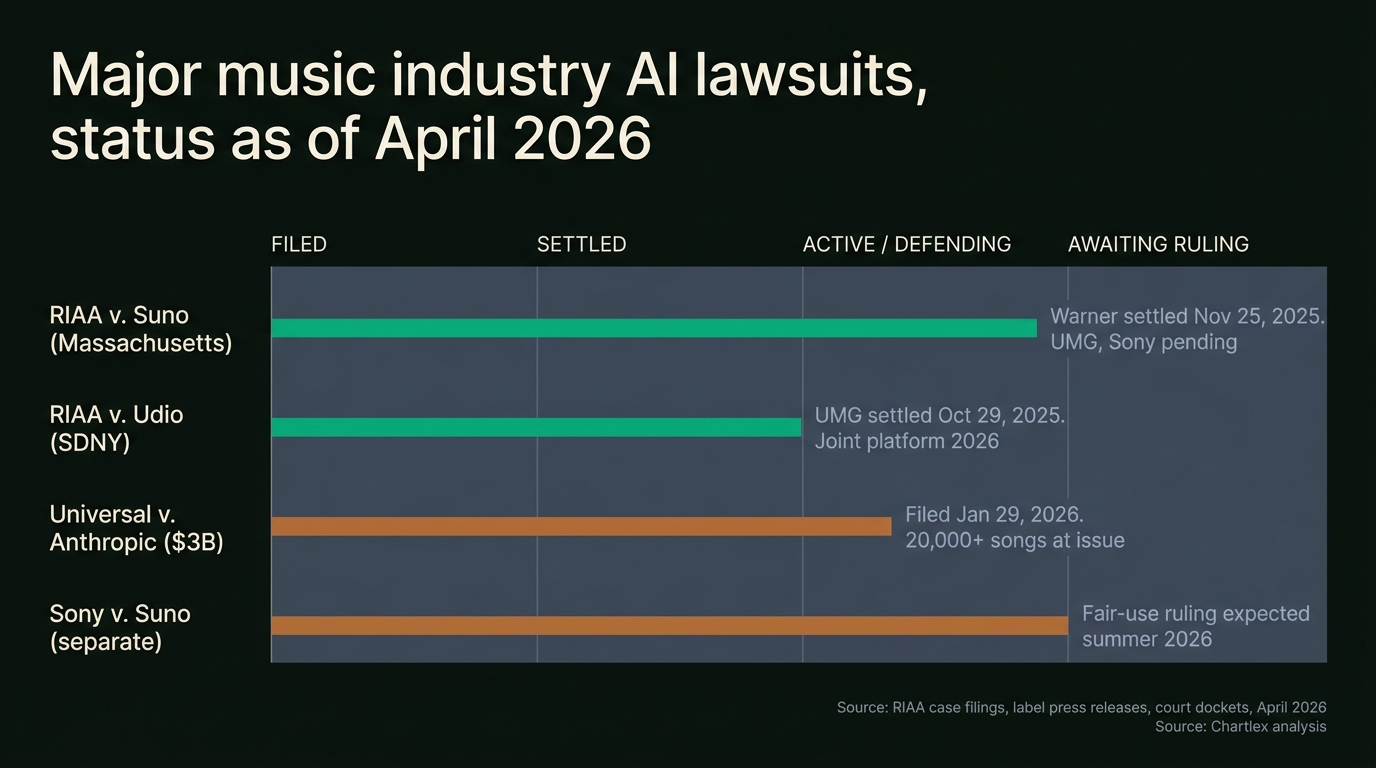
Active Cases (Status as of August 20, 2026)
Every status below was re-verified against a live source (court docket, official release, or the reporting cited) on August 20, 2026. Where something rests on trade reporting rather than a document we could read off the docket, we say so.
Case Status at a Glance
| Case | Court | Filed | Latest development | Status |
|---|---|---|---|---|
| UMG and Sony v. Suno | D. Mass. (1:24-cv-11611) | June 24, 2024 | Amended schedule (reported July 10, 2026): fact discovery and depositions to September 30, 2026; dispositive motions April 9, 2027 | Active; no US fair-use ruling expected in 2026 |
| Sony v. Udio (original case) | SDNY (1:24-cv-04777) | June 24, 2024 | Document discovery runs to August 25, 2026; status conference September 18, 2026 | Active; Sony is the last major plaintiff |
| Sony v. Udio (second case) | SDNY | July 20, 2026 | Filed asserting 30,117 additional sound recordings | Active; newly filed |
| GEMA v. Suno | Munich Regional Court I | January 21, 2025 | Ruled for GEMA July 31, 2026: prohibitions on six compositions, disclosure order, damages liability | First-instance ruling for GEMA; Suno evaluating an appeal, none filed as of August 20, 2026 |
| GEMA v. OpenAI | Munich Regional Court I | November 13, 2024 | Ruled for GEMA November 11, 2025 | First-instance ruling for GEMA; appeal status unconfirmed |
| Concord I v. Anthropic | N.D. Cal. (5:24-cv-03811) | October 18, 2023 | Second Amended Complaint filed July 22, 2026, citing internal Anthropic records | Active |
| Concord II v. Anthropic | N.D. Cal. (5:26-cv-00880) | January 28, 2026 | Anthropic's response was due August 3, 2026 | Active; roughly $3B sought |
| BMG v. Anthropic | N.D. Cal. | March 2026 | Filed, citing 493 compositions | Active; early stage |
| Justice v. Suno | D. Mass. (1:25-cv-11739) | June 14, 2025 | Motion to dismiss under advisement since March 20, 2026 | Active |
| Justice v. Udio | SDNY (1:25-cv-05026) | June 16, 2025 | Amended complaint filed June 22, 2026 | Active |
| Kim v. Uncharted Labs (Udio) | SDNY | January 2026 | Filed as a class action for independent artists outside the major-label settlements | Active; early stage |
| Woulard v. Udio | N.D. Ill. (1:25-cv-12613) | October 15, 2025 | Jurisdiction ruling was due about July 15, 2026; outcome unconfirmed as of August 20, 2026 | Active |
| AFM v. UMG and Warner | SDNY | June 5, 2026 | Amended complaint filed July 27, 2026 | Active |
UMG and Sony v. Suno (D. Mass., 1:24-cv-11611)
Filed: June 24, 2024, US District Court for the District of Massachusetts (Judge F. Dennis Saylor IV). Plaintiffs at filing: UMG, Sony, and Warner label entities (RIAA-coordinated). Current status (verified August 20, 2026):
- Warner settled (announced November 25, 2025: undisclosed payment, licensing partnership, Suno acquiring Songkick from WMG). The Warner plaintiffs filed their stipulation of voluntary dismissal December 9, 2025, and the court entered the order January 28, 2026.
- UMG and Sony are still active plaintiffs. No fair-use or summary judgment ruling has issued.
- A magistrate judge denied UMG and Sony access to the Warner-Suno deal terms in an April 6, 2026 discovery ruling; that ruling still stands.
- On May 21, 2026 UMG and Sony moved for leave to file a second amended complaint adding works identified through discovery. Suno opposed on June 4; the motion was still pending at our last docket read.
- The operative amended scheduling order (reported July 10, 2026 by TechTimes and confirmed on the docket) runs fact discovery and depositions to September 30, 2026 and sets dispositive motions for April 9, 2027. The "summer 2026 ruling" that earlier coverage (including our April version of this page) expected is not happening; on this schedule a fair-use merits decision is a 2027 event at the earliest.
- One clarification worth stating plainly: there was no US summary-judgment hearing in July 2026. Some outlets conflated a "July 2026 Suno hearing" with the Munich GEMA v. Suno ruling of July 31, 2026, which is a different case in a different country (covered below).
What's at stake: Suno argues that training generative models on copyrighted recordings is transformative fair use. The labels argue it is infringement at industrial scale. These remain allegations; no court has ruled on the fair-use question in this case. A ruling against Suno would force every AI music company to license training data or shut down. A ruling for Suno would gut the labels' negotiating leverage and reset the licensing market overnight.
Sony v. Uncharted Labs / Udio (SDNY, 1:24-cv-04777, plus a second case filed July 2026)
Filed: June 24, 2024, Southern District of New York (Judge Alvin K. Hellerstein). Plaintiffs at filing: UMG, Sony, and Warner label entities. Current status (verified August 20, 2026):
- UMG settled (announced October 29, 2025: compensatory payment plus licensing deal for an AI platform planned for 2026). UMG and Capitol filed their dismissal stipulation November 4, 2025. Forbes reporting (December 18, 2025) put numbers on the deal: a per-generation royalty of $0.002 to $0.005, higher for commercial distribution, content-identification audit rights, and coverage of future model versions.
- Warner also settled with Udio; its dismissal stipulation was filed November 25, 2025. Terms were not disclosed.
- Trade reporting, not primary-verified against a filing, says Merlin settled with Udio in January 2026 and Kobalt in April 2026.
- Sony (with Arista) is the last major still litigating against Udio, on the original 333 asserted works.
- On April 15, 2026 the court declined to dismiss Sony's DMCA anti-circumvention claim over how Udio allegedly obtained training audio from YouTube.
- On June 30, 2026 the court denied Sony's motion to add 30,442 additional recordings, writing that expanding the case near the close of document discovery would "materially alter the scope of the case."
- Sony's answer to that denial: on July 20, 2026 it filed a second, separate SDNY lawsuit against Udio asserting 30,117 additional sound recordings, effectively moving the excluded catalog into its own case (Variety and Music Business Worldwide, July 20, 2026).
- In the original case, document discovery runs to August 25, 2026; the next status conference is September 18, 2026. No fair-use ruling has issued here either.
- As of August 20, 2026 neither UMG nor Udio has issued a release confirming the joint licensed platform is publicly launched; it remains slated for 2026, and the October 2025 announcement remains the latest official word.
What's at stake: The UMG-Udio platform is planned as a "walled garden" where AI creations cannot be downloaded or posted outside the site, with opt-in compensation for UMG artists and songwriters. Sony's continuing cases, now two of them, will test whether the walled-garden model becomes the industry standard or whether broader fair-use protections survive.
Publishers v. Anthropic (three cases, N.D. Cal.)
Concord I (5:24-cv-03811). Filed October 18, 2023 (originally M.D. Tennessee, transferred to the Northern District of California, Judge Eumi K. Lee). Concord, Universal Music Publishing Group entities, and ABKCO allege Claude was trained on and reproduces their song lyrics. On October 6, 2025 the court denied Anthropic's motion to dismiss the contributory infringement, vicarious infringement, and DMCA claims, so those proceed alongside the direct infringement claim. The January 2025 stipulated guardrails on Claude's lyric outputs remain in effect. On July 22, 2026 the publishers filed a Second Amended Complaint citing internal Anthropic records, including allegations that copyright notices were stripped from lyrics during training (CelebrityAccess, July 27, 2026; Music Business Worldwide). No trial date has been set.
Concord II (5:26-cv-00880). Filed January 28, 2026. This is a separate new lawsuit, not an amendment of the 2023 case, and it names Anthropic CEO Dario Amodei and co-founder Benjamin Mann as individual defendants. The publishers allege Anthropic obtained more than 20,000 musical works from pirate "shadow libraries" for training and seek roughly $3 billion, which the plaintiffs describe as the largest non-class-action copyright case in US history. On April 24, 2026 the court denied Anthropic's motion to stay the case pending Concord I; Anthropic's motion to dismiss or answer was due August 3, 2026, and we have not yet confirmed what was filed.
BMG v. Anthropic. Filed March 2026, a third publisher suit citing 493 compositions. Early stage; allegations only.
Why it matters: These are publishing lawsuits, not recordings lawsuits: the disputed rights are compositions and lyrics. The legal theory leans on the June 23, 2025 Bartz v. Anthropic summary judgment ruling, which held that training on lawfully acquired books can be fair use but that sourcing from pirate libraries is not protected. One thing not to conflate: Anthropic's roughly $1.5 billion Bartz class settlement (which was still awaiting final approval after the May 14, 2026 fairness hearing at our last check) is about books, not music; none of that money is earmarked for the publishers here. Everything in Concord II and the BMG case is at the allegation stage; no court has ruled on their merits.
Independent Artist Class Actions (four cases)
- Justice et al. v. Suno (D. Mass., 1:25-cv-11739). Filed June 14, 2025 by country artist Tony Justice and his label and publishing companies, on behalf of a proposed class of independent artists whose works were on streaming services since January 1, 2021. Suno's motion to dismiss was argued March 20, 2026 and remains under advisement at our last check; no ruling reported.
- Justice et al. v. Udio (SDNY, 1:25-cv-05026). Filed June 16, 2025, the SDNY sibling case against Udio. Early stage; trade reporting indicates an amended complaint was filed June 22, 2026.
- Kim v. Uncharted Labs (SDNY). Filed January 2026, a class action by independent artists whose recordings are not covered by the major-label settlements with Udio. Early stage; allegations only. Source: Music In Africa.
- Woulard et al. v. Udio (N.D. Ill., 1:25-cv-12613). Filed October 15, 2025. Udio moved to dismiss for lack of personal jurisdiction on February 6, 2026; the ruling was due about July 15, 2026, but the outcome is unconfirmed as of August 20, 2026.
These cases matter because they cover artists who are not on major labels. If you released music to streaming platforms before mid-2024 and your distributor delivered to commercial DSPs, your master recordings were potentially in the training pool. The class actions are the only vehicle most independent artists have for any direct recovery, and all of them are still at the allegation stage.
GEMA v. OpenAI and GEMA v. Suno (Munich)
- GEMA v. OpenAI (Landgericht Muenchen I, 42 O 14139/24). Filed November 13, 2024. On November 11, 2025 the Munich Regional Court largely ruled for GEMA: memorization and reproduction of nine German song lyrics by ChatGPT infringed copyright, and the text-and-data-mining exception did not cover it. The court granted an injunction with penalties of up to EUR 250K per violation and held OpenAI liable for damages. This is a first-instance ruling; OpenAI said it would appeal, but the appeal status is unconfirmed as of August 20, 2026.
- GEMA v. Suno (Landgericht Muenchen I). Filed January 21, 2025, the first European case about AI training on audio, and now the first European ruling on a generative AI music tool. On July 31, 2026 the court ruled in GEMA's favor. Regarding the six test compositions, it prohibited four acts: reproduction through training in the US, memorisation reproduction in Germany, communication to the public by offering the model, and communication to the public via the model's outputs. It also ordered Suno to disclose the scale of use and held Suno liable for damages, with the amount still to be determined. Under German civil procedure the judgment is immediately enforceable even pending appeal. Suno says it disagrees with the decision and is evaluating an appeal to the Munich Court of Appeal; no appeal filing is confirmed as of August 20, 2026. Sources: Bird and Bird client briefing; Variety and Music Ally, July 31, 2026.
AFM v. UMG and Warner (SDNY, filed June 5, 2026)
The American Federation of Musicians sued UMG and Warner Music Group, alleging the labels licensed AFM-member session recordings to Suno and Udio for AI training without the compensation or consent the union's collective bargaining agreement's new-use provision requires. This is the first major suit aimed at the settlements themselves rather than at the AI companies. An amended complaint was filed July 27, 2026 (Hollywood Reporter; Digital Music News); we have only confirmed the filing itself, not its contents. Allegations only, no rulings.
US v. Michael Smith (SDNY, criminal AI streaming-fraud case)
Not a copyright case, but it belongs in any 2026 map of music-and-AI litigation: the federal prosecution of Michael Smith for using AI-generated tracks and bot accounts to harvest streaming royalties at scale. Smith pleaded guilty on March 19 to 20, 2026 to one count of conspiracy to commit wire fraud before Judge John G. Koeltl, agreed to forfeit $8,091,843.64, and faces a maximum of 5 years (DOJ SDNY release, via Music Ally, March 20, 2026). A sentencing hearing was held July 29, 2026; the outcome is not yet confirmed in public reporting as of August 20, 2026 (TechTimes, July 28, 2026). For artists, this is the case DSPs and distributors point to when tightening AI-upload and anti-fraud policies.
First Push
Never put money behind a track before? First Push is the smallest way to find out how one song responds over about four weeks, and it counts toward anything bigger later.
- ✓About 600 new monthly listeners on one track
- ✓Paced over roughly four weeks, not a single burst
- ✓100% credits toward a bigger campaign within 30 days
- ✓The lowest cost way to try one track
Pick your track here. Credit applies if you upgrade within 30 days.
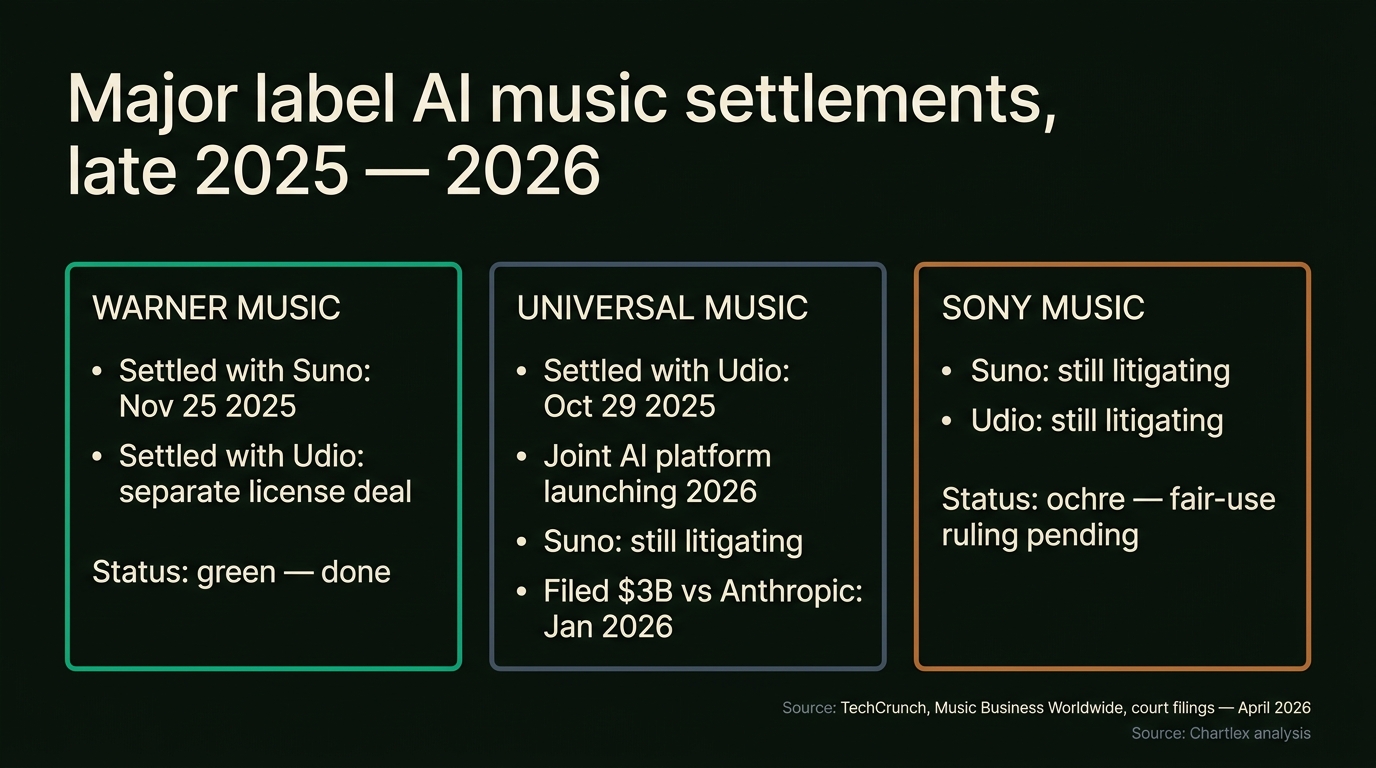
Settlement Tracker
| Plaintiff | Defendant | Status | Key date | Public terms / posture |
|---|---|---|---|---|
| Warner Music Group | Suno | Settled (dismissal entered Jan 28, 2026) | Announced Nov 25, 2025 | Undisclosed payment; licensing partnership; Suno acquires Songkick from WMG; new licensed Suno models planned for 2026 with download caps; artist opt-in controls |
| Universal Music Group | Udio | Settled (dismissal filed Nov 4, 2025) | Announced Oct 29, 2025 | Compensatory payment; per Forbes (Dec 18, 2025): per-generation royalty of $0.002 to $0.005, higher for commercial distribution, audit rights, coverage of future model versions; licensed walled-garden platform planned for 2026, launch not yet officially confirmed as of Aug 20, 2026 |
| Warner Music Group | Udio | Settled (dismissal filed Nov 25, 2025) | Nov 2025 | Terms not disclosed |
| Merlin and Kobalt | Udio | Reportedly settled (trade reporting, not primary-verified) | Merlin Jan 2026; Kobalt Apr 2026 | Terms not disclosed |
| UMG and Sony | Suno | Active litigation | Dispositive motions due Apr 9, 2027 | No ruling; second motion to amend pending at last docket read; Apr 6, 2026 denial of access to Warner-Suno deal terms stands |
| Sony Music | Udio | Active litigation, now two cases | Second suit filed Jul 20, 2026 | Original case held at 333 works (expansion to 30,442 denied Jun 30, 2026; DMCA claim survived dismissal Apr 15, 2026); second SDNY suit asserts 30,117 additional recordings |
| Justice class actions | Suno (D. Mass.), Udio (SDNY) | Active; allegations only | Filed Jun 14 and 16, 2025 | Suno MTD under advisement since Mar 20, 2026; no public settlement |
| Kim class action | Udio (Uncharted Labs) | Active; newly filed | Filed Jan 2026 | Class of independent artists outside the major-label settlements; no public settlement |
| Woulard class action | Udio | Active; jurisdiction ruling outcome unconfirmed as of Aug 20, 2026 | Filed Oct 15, 2025 | Ruling was due about Jul 15, 2026; no public settlement |
| Concord / UMPG / ABKCO, plus BMG | Anthropic (+ Amodei, Mann in Concord II) | Three active cases; allegations only | Second Amended Complaint filed Jul 22, 2026 | 20,000+ songs and roughly $3B sought in Concord II (response was due Aug 3, 2026); BMG suit (Mar 2026) cites 493 compositions |
| GEMA | OpenAI | First-instance ruling for GEMA | Nov 11, 2025 | Injunction, disclosure, damages over nine lyrics; not final; appeal status unconfirmed |
| GEMA | Suno | First-instance ruling for GEMA | Jul 31, 2026 | Prohibitions on six compositions across training and outputs; disclosure order; damages liability; immediately enforceable; Suno evaluating appeal |
| AFM (musicians' union) | UMG, Warner | Active; amended complaint filed Jul 27, 2026 | Filed Jun 5, 2026 | Union alleges member recordings licensed to Suno/Udio for training without consent |
The pattern: majors that wanted a stake in the new platforms settled. The major that wanted a precedent (Sony) is still in court, and now in two courtrooms against Udio, but the US precedent is on a 2027 clock. Independent artists are relying on class actions that are all still at the motion stage, and the first ruling of any kind landed in Munich, where GEMA won against Suno on July 31, 2026.
What a US Fair-Use Ruling Could Mean (Now a 2027 Question)
First, the timing correction. Earlier versions of this page (and a lot of trade coverage) expected a "summer 2026" fair-use ruling in Sony's cases. The dockets say otherwise: in the Massachusetts Suno case, dispositive motions are not due until April 9, 2027, and in the original SDNY Udio case document discovery runs to August 25, 2026 with a status conference in September. The nearest actual decision arrived on schedule, but from Munich: GEMA won its first-instance ruling against Suno on July 31, 2026 (covered above). It is a German ruling under EU law, so it binds nobody in a US courtroom, but it is the first time any court anywhere has ruled on a generative AI music tool's training and outputs, and it will be quoted in every US brief. The Woulard jurisdiction ruling was due about July 15, 2026; its outcome is unconfirmed as of August 20, 2026.
When the US fair-use question does get decided, three plausible scenarios. None of them are good news for AI music companies that thought they could ride the same playbook OpenAI did.
Scenario A: Sony wins on fair-use. The court rules that training generative AI music models on copyrighted recordings without a license is infringement, not transformative use. Every AI music company faces a forced choice: license, shut down, or rebuild on opt-in or public-domain training data only. Suno and Udio's existing settlements get retroactively expensive. Smaller competitors (Stable Audio, Mubert, Riffusion-derivatives) face the same exposure without Warner or UMG behind them. Expect a wave of licensing deals and a flight to walled-garden models.
Scenario B: Sony loses on fair-use. The court rules training is transformative and protected. The labels' leverage collapses. Existing settlements still stand because they include licensing components, but the price of future licenses falls dramatically. AI music tools proliferate. Independent artists lose any realistic path to compensation for training data. The walled-garden model becomes a competitive choice rather than a legal necessity.
Scenario C: Mixed ruling. The court splits training from output. Training on legally acquired recordings is fair use; training on pirated recordings is not; outputs that closely replicate specific copyrighted works are infringement. This is the most likely outcome based on the June 2025 Bartz v. Anthropic logic. It forces AI music companies to clean up their training-data provenance and aggressively filter outputs, but it does not kill the business model.
The realistic base case is Scenario C, which is why Anthropic's separate $3 billion exposure is so significant. The publishers' theory is that Anthropic torrented lyrics rather than licensing them, and the Bartz precedent says torrenting is not protected even if training is.
The Regulatory Layer (Added August 2026)
The courts are no longer the only front. Two regulatory developments in mid-2026 change the ground the lawsuits are fought on.
EU AI Act Article 50 (enforceable August 2, 2026). The AI Act's transparency obligations became generally applicable and enforceable across the EU on August 2, 2026. Two limbs matter for music. First, AI systems that generate synthetic audio must mark their outputs as AI-generated in a machine-detectable way, which gives DSPs and distributors a technical hook for the provenance checks they have been demanding contractually. Second, makers of general-purpose AI models must publish a sufficiently detailed summary of the content used for training and honor rights-reservation opt-outs, meaning an AI company cannot legally train on EU-market tracks carrying opt-out metadata without a license. Models already on the market before August 2025 have until 2027 to fully comply on the copyright limb. Penalties run up to EUR 15M or 3% of global annual turnover, whichever is higher. Sources: Goodwin Law and Cooley client briefings (August 2026), Music Business Worldwide, Music Ally (August 4, 2026).
NO FAKES Act (S.4591, US federal). The bill creating a federal right against unauthorized AI voice and likeness replicas passed the Senate Judiciary Committee by unanimous voice vote on June 18, 2026. It now awaits a full Senate floor vote, with no date set as of August 20, 2026. Sources: Grammy.com, Deadline, Congress.gov.
At the state level, Tennessee's ELVIS Act remains the template for voice-clone protection; it has been unchanged since taking effect July 1, 2024.
What This Means for Independent Artists
The lawsuits are interesting; what to actually do about them is more useful.
Can you safely use Suno-generated music on Spotify in 2026?
The honest answer is: it depends on which Suno model and which distributor. After the Warner settlement, Suno is rolling out new licensed models in 2026 and terminating the old ones. Output from the new licensed models is on cleaner legal ground for commercial release than output from pre-settlement models. Output from the pre-settlement models is in legal limbo and may face takedowns if a copyright owner identifies a stylistic match.
Spotify's policy currently allows AI-generated music as long as the uploader holds the rights and the upload does not mimic a specific identifiable artist. Spotify removed tens of thousands of AI-generated tracks in 2024-2025 that violated those terms.
Distributor policies on AI-generated music
Distributors have tightened their AI policies through 2025-2026. Verify your distributor's current AI policy before uploading any AI-generated or AI-assisted music. Policies are evolving fast. The risk is takedown, not just rejection: a track distributed under a policy that later changes can be pulled retroactively.
Royalty implications
If your track is purely AI-generated with no human creative input, you may not have a copyrightable work in the US under current Copyright Office guidance, which means no PRO performance royalties on the composition side. Mechanical royalties on the master may still flow if your distributor delivers correctly, but the publishing side is shaky. For an explainer on how the publishing side works in 2026, see music publishing explained for independent artists.
Copyright registration for AI-assisted vs AI-generated tracks
The US Copyright Office has consistently held that purely AI-generated work without human authorship is not copyrightable. AI-assisted work where a human directs, arranges, edits, or substantially modifies the output can be registered, but the registration must disclose the AI involvement and only covers the human contribution. For the full registration walkthrough including how to disclose AI involvement, see how to copyright your music: complete guide.
The practical rule: AI as a tool, with substantial human creative direction and editing, is registrable. AI as the sole author is not.
What This Means for Music Industry Pros
| Stakeholder | What changes in 2026 |
|---|---|
| Major labels | Two of three have settled into licensing partnerships. Equity-and-licensing is the dominant model. Sony's outcome will reset leverage either way. |
| Independent labels | No equity in walled gardens. Class actions and PRO/MLC enforcement are the main recovery vehicles. |
| Music publishers | Anthropic case is the bellwether. If publishers prevail, every AI company that touched lyrics is on the hook. |
| Sync agencies | AI-generated music creates clearance nightmares. Music supervisors are increasingly demanding written warranties that no AI training data infringement is embedded in submitted tracks. |
| DSPs (Spotify, Apple, YouTube) | Tightening AI upload policies. Expect more aggressive takedowns and provenance requirements through 2026. |
| M&A pros | Suno and Udio valuations now include licensing-cost overhang. Expect downstream AI music startups to be valued on training-data provenance, not just user metrics. |
| Lawyers | Whenever the US fair-use question is decided (dispositive motions in the D. Mass. Suno case are due April 9, 2027), it will become the most-cited music copyright decision of the decade. Until then, the GEMA rulings in Munich are the closest thing to precedent. |
For the broader question of how AI cloning specifically affects independent artists and what protective steps exist, see protect your music from AI cloning.
Primary Dockets
The five US dockets this tracker relies on most are publicly readable on CourtListener:
- UMG Recordings, Inc. v. Suno, Inc., 1:24-cv-11611 (D. Mass.) including the amended scheduling order setting dispositive motions for April 9, 2027
- UMG Recordings, Inc. v. Uncharted Labs (Udio), 1:24-cv-04777 (S.D.N.Y.)
- Concord Music Group, Inc. v. Anthropic PBC, 5:24-cv-03811 (N.D. Cal.)
- Concord Music Group, Inc. v. Anthropic PBC (second action), 5:26-cv-00880 (N.D. Cal.)
- Woulard v. Udio, 1:25-cv-12613 (N.D. Ill.) for the independent-artist jurisdiction fight
A docket number for Sony's second SDNY lawsuit against Udio (filed July 20, 2026) had not been confirmed in our sources as of August 20, 2026.
German proceedings (GEMA v. OpenAI, GEMA v. Suno) are tracked via the Munich Regional Court I press office and GEMA's official releases; German dockets are not published online.
Update Log
Every material change to this tracker, newest first, with the source it came from.
August 20, 2026 refresh. Every case above was re-verified against a live source on this date.
- Added the headline: GEMA v. Suno was decided July 31, 2026 in GEMA's favor, the first European ruling on a generative AI music tool. The Munich Regional Court I prohibited four acts regarding six compositions (reproduction through US training, memorisation reproduction in Germany, communication to the public by offering the model, and via outputs), ordered disclosure of the scale of use, and held Suno liable for damages, with the judgment immediately enforceable pending appeal; Suno is evaluating an appeal, none filed as of this date. Sources: Bird and Bird client briefing; Variety, July 31, 2026; Music Ally, July 31, 2026.
- Added Sony's second SDNY lawsuit against Udio, filed July 20, 2026, asserting 30,117 additional sound recordings. Sources: Music Business Worldwide; Variety, July 20, 2026.
- Added the UMG-Udio settlement terms reported by Forbes on December 18, 2025 (per-generation royalty of $0.002 to $0.005, higher for commercial distribution, audit rights, coverage of future model versions) and the reported, not primary-verified, Merlin (January 2026) and Kobalt (April 2026) settlements with Udio.
- Expanded the Anthropic thread to three cases: added BMG's March 2026 suit (493 compositions) and the July 22, 2026 Second Amended Complaint citing internal Anthropic records, including allegations that copyright notices were stripped from lyrics during training. Sources: TechCrunch, January 29, 2026; IPWatchdog; CelebrityAccess, July 27, 2026; Music Business Worldwide.
- Added Kim v. Uncharted Labs (SDNY, filed January 2026) to the independent-artist cases and marked the Woulard v. Udio jurisdiction ruling (due about July 15, 2026) as outcome unconfirmed as of August 20, 2026. Sources: Music In Africa; CourtListener docket 71659116.
- Noted the AFM amended complaint of July 27, 2026 (filing only; contents not verified). Sources: Hollywood Reporter; Digital Music News, July 27, 2026.
- Added US v. Michael Smith, the SDNY criminal AI streaming-fraud case: guilty plea March 19 to 20, 2026 with an agreed forfeiture of $8,091,843.64 and a 5-year maximum; sentencing hearing held July 29, 2026, outcome not yet confirmed in public reporting. Sources: DOJ SDNY release via Music Ally, March 20, 2026; TechTimes, July 28, 2026.
- Added a regulatory-layer section: EU AI Act Article 50 transparency obligations enforceable August 2, 2026 (audio output marking, training-content summaries, opt-out compliance; penalties up to EUR 15M or 3% of global turnover) and the NO FAKES Act's June 18, 2026 Senate Judiciary Committee passage, floor vote not yet scheduled. Sources: Goodwin Law; Cooley, August 3, 2026; Music Business Worldwide; Music Ally, August 4, 2026; Grammy.com; Deadline; Congress.gov S.4591.
- Corrected the record on the "July 2026 Suno hearing": there was no US summary-judgment hearing in July 2026; some outlets conflated it with the Munich GEMA ruling. Confirmed the D. Mass. schedule (fact discovery and depositions to September 30, 2026; dispositive motions April 9, 2027; amended order reported July 10, 2026 by TechTimes) and the SDNY schedule (document discovery to August 25, 2026; status conference September 18, 2026); the April 6, 2026 magistrate ruling on the Warner-Suno deal terms still stands. Sources: ailawsuittracker.com; CourtListener docket 68878608; TechTimes, July 10, 2026.
- Added the Case Status at a Glance table.
Free Spotify Audit
See exactly where your Spotify profile is leaking growth.
One audit finds an average of 4 growth blockers per artist profile.
Pro Growth Plan
$599/mo
Serious about building a music business? Consistent algorithmic momentum puts you on Spotify's radar.
Verified in Spotify for Artists · Geo-targeted · Cancel anytime
July 11, 2026 refresh. Every case above was re-verified against primary sources on this date.
- Removed the "Sony fair-use ruling expected summer 2026" framing everywhere. Source: the June 30, 2026 amended scheduling order in UMG v. Suno, D. Mass. 1:24-cv-11611 (dispositive motions due April 9, 2027) and the June 29, 2026 SDNY scheduling order in 1:24-cv-04777 (document discovery to August 25, 2026), both on the public CourtListener dockets.
- Confirmed Warner's court exits on both dockets: Suno-case stipulation of dismissal filed December 9, 2025 (order entered January 28, 2026) and Udio-case stipulation filed November 25, 2025. UMG/Capitol's Udio dismissal stipulation was filed November 4, 2025. Sources: D. Mass. and SDNY dockets; WMG press release of November 25, 2025; UMG-Udio press release of October 29, 2025.
- Added the 2026 Sony v. Udio rulings: DMCA anti-circumvention claim survived dismissal (April 15, 2026) and Sony's motion to add 30,442 recordings was denied (June 30, 2026), holding the case at 333 works. Sources: SDNY docket; Music Business Worldwide reporting on the orders.
- Corrected the Anthropic entry: the January 28, 2026 filing is a separate second lawsuit (N.D. Cal. 5:26-cv-00880) naming Dario Amodei and Benjamin Mann, with a stay denied April 24, 2026 and Anthropic's response due August 3, 2026. Source: CourtListener docket and the filed complaint.
- Corrected the class-action dates: Justice v. Suno filed June 14, 2025 and Justice v. Udio filed June 16, 2025 (the earlier "filed October 2025" claim was wrong for these); Woulard v. Udio filed October 15, 2025 with a jurisdiction ruling set for July 15, 2026. Sources: the three dockets.
- Added the GEMA cases (OpenAI ruling of November 11, 2025, not final; Suno verdict scheduled July 31, 2026). Sources: Munich Regional Court I press office; GEMA releases.
- Added AFM v. UMG and Warner (filed June 5, 2026, SDNY). Source: the filed complaint; docket number not yet confirmed.
- Noted the Bartz v. Anthropic settlement is still awaiting final approval after the May 14, 2026 fairness hearing. Source: N.D. Cal. docket 4:24-cv-05417.
April 28, 2026. Tracker first published, covering the RIAA label cases, the Warner-Suno and UMG-Udio settlements, the Anthropic publishing litigation, and the independent-artist class actions.
How to Stay Updated
This page is updated when we re-verify the cases; the "Last verified" date in the Quick Answer and the update log above tell you exactly how fresh it is. There is no fixed refresh schedule, so treat any status here as a snapshot of the last verification date, and check the linked dockets for anything decision-critical.
Primary sources we verify against:
- The public court dockets (CourtListener/RECAP mirrors of PACER) for the Massachusetts, SDNY, N.D. Cal., and N.D. Ill. cases
- Official press releases from the labels, publishers, Suno, Udio, Anthropic, and GEMA for settlement announcements
- The Munich Regional Court I press office for the German cases
- Trade reporting (Music Business Worldwide, Billboard, Digital Music News) for context, never as the sole source for a procedural status
Frequently Asked Questions
Is Suno legal in 2026?
Suno is operational in 2026 under a settlement with Warner Music and ongoing litigation with UMG and Sony, plus an independent-artist class action. It now also operates under an adverse first-instance ruling in Germany: on July 31, 2026 the Munich Regional Court prohibited Suno's use of six GEMA compositions across training and outputs, ordered disclosure, and held it liable for damages, with the judgment immediately enforceable while Suno evaluates an appeal. Pre-settlement Suno models are in legal limbo. The new licensed models are on cleaner ground for commercial use, but the underlying US fair-use question is unresolved, and on the current court schedule it will not be decided before 2027.
Can I monetize AI-generated music on Spotify?
You can attempt to, but with caveats. Spotify allows AI-generated uploads that do not mimic a specific identifiable artist and where the uploader holds rights. Distributors have tightened AI policies through 2025-2026. Purely AI-generated tracks may not be copyrightable in the US, which limits publishing royalty collection.
Did Sony settle with Suno?
No. As of August 20, 2026, Sony Music has not settled with Suno or Udio. Sony litigates the original Udio case alone (UMG and Warner both dismissed their claims after settling), filed a second SDNY lawsuit against Udio on July 20, 2026 covering 30,117 additional recordings, and continues the Suno case in Massachusetts together with UMG. No US fair-use ruling has issued in any of these cases, and the Massachusetts schedule puts dispositive motions in April 2027.
What did UMG settle with Udio?
On October 29, 2025, UMG and Udio settled their copyright case and announced a joint AI music platform planned for 2026. The platform is designed as a "walled garden" where AI creations cannot be downloaded or posted externally, with opt-in compensation for UMG artists and songwriters. Forbes reporting (December 18, 2025) described a per-generation royalty of $0.002 to $0.005, higher for commercial distribution, plus audit rights and coverage of future model versions. UMG filed its dismissal on November 4, 2025. As of August 20, 2026 neither company has officially confirmed the platform's public launch.
Will the Sony Suno case set legal precedent?
Yes, if it reaches a ruling rather than settling, but not on the timeline earlier coverage suggested. The case directly addresses whether training generative AI models on copyrighted recordings without a license is fair use, and a ruling either way will be cited in every subsequent AI copyright case. Under the June 30, 2026 scheduling order, though, dispositive motions are not due until April 9, 2027, so a merits ruling is a 2027 event at the earliest.
What's the $3 billion Universal lawsuit about?
On January 28, 2026, Concord, Universal Music Publishing Group, and ABKCO filed a second, separate lawsuit against Anthropic (it did not replace the 2023 case, which continues in parallel) covering over 20,000 songs, seeking roughly $3 billion, and naming CEO Dario Amodei and co-founder Benjamin Mann personally. The publishers allege Anthropic obtained lyrics and compositions from pirate libraries to train Claude, leaning on the June 23, 2025 Bartz ruling that piracy-sourced training material is not protected by fair use. These are allegations; Anthropic's response was due August 3, 2026, and no ruling has issued. A third publisher suit, from BMG citing 493 compositions, followed in March 2026.
Are AI-generated tracks copyrightable?
In the US, purely AI-generated works without human authorship are not copyrightable under current Copyright Office guidance. AI-assisted works with substantial human creative direction, arrangement, or editing can be registered, but the registration must disclose AI involvement and only protects the human contribution. Other jurisdictions handle this differently.
What happens if my AI track gets a copyright strike?
If a copyright owner files an infringement claim, your distributor will typically pull the track from DSPs while the dispute resolves. You may need to provide proof of rights, training-data provenance, or stem files. Repeated strikes can result in account termination at some distributors. Document your creative process and AI tool versions for every release.
Can I license AI-generated music for film and TV?
Sync agencies and music supervisors increasingly require written warranties that submitted tracks are clear of AI training-data infringement. AI-generated tracks face a higher clearance bar than human-composed tracks because of unresolved provenance questions. Read your sync platform's AI policy carefully. Some libraries reject AI-generated submissions outright.
Where to Go From Here
The legal layer is one piece of the picture. The practical layer is making sure your music, your rights, and your business are set up to capture what is yours regardless of how the AI cases resolve.
- AI music licensing deals tracker 2026 covers the other side of the docket: every label and publisher deal signed with AI platforms, with dates and terms.
- Music copyright basics for independent artists covers the foundation every artist needs before worrying about AI-specific risks.
- How to copyright your music: complete guide walks through registration including disclosure for AI-assisted works.
- Protect your music from AI cloning covers practical protective steps for voice and likeness.
- Music publishing explained for independent artists covers PROs, MLC, and the publishing pipeline that AI lawsuits ultimately flow through.
- AI tools for indie musicians: hype vs reality is a clear-eyed look at which AI tools are worth using right now and which are legal landmines.
If you want a clear read on where your catalog stands and how to grow listeners on the human-creative side of the line, get your free Chartlex audit and we will map out the next moves.
Free Weekly Playbook
One actionable insight, every Tuesday.
Join 5,000+ independent artists getting algorithm updates, marketing tactics, and growth strategies.
No spam. Unsubscribe anytime.
Get a business health check for your music career.
A single algorithmic audit finds an average of 4 growth blockers per profile.
Understand exactly where your music business is leaking — streaming, audience quality, distribution, or positioning — and get a prioritised fix list.
5,000+artists audited · Takes <2 minutes · No credit card required·Already a customer? Open Dashboard →
Campaign Dashboard
Turn Knowledge Into Action
Track your streams, monitor algorithmic triggers, and see growth projections in real time. The Campaign Dashboard puts everything you just read into practice.
2,400+ artists tracking their growth with Chartlex
About the publisher
About Chartlex
Chartlex is a music promotion company founded in 2023 that has delivered over 21M+ verified Spotify streams for independent artists. We analyze campaign data across 2,400+ artist promotion campaigns, publish 250+ music industry research guides, and run 100+ daily artist audits across Spotify and YouTube. Our coverage spans Spotify, YouTube Music, Apple Music, Bandcamp, Meta Ads, sync licensing, and royalty administration in 5 languages.
- Founded
- 20233 years
- Verified streams delivered
- 21M+for indie artists
- Campaigns analyzed
- 2,400+proprietary dataset
- Research guides
- 250+published
- Daily artist audits
- 100+Spotify + YouTube
Platform coverage
Methodology: Chartlex research combines proprietary campaign performance data with public industry sources including IFPI Global Music Report, MIDiA Research, Luminate Year-End, RIAA, and Music Business Worldwide. All findings are refreshed quarterly. Last verified: 2026-10-09.
Keep reading
Live tracker of 2026 music catalog acquisitions: deal values, multiplier ranges, and what billion-dollar publishing deals mean for indie artists.
Daniel Brooks
Live tracker of music industry layoffs in 2026: Spotify, Warner, UMG, Bandcamp, Splice, Stability AI. Headcount, severance, and what's driving the cuts.
Daniel Brooks
12 verified Q1 2026 music industry numbers: streaming growth, Spotify ARPU, vinyl, sync, AI lawsuits, M&A, layoffs, indie share, and chart concentration.
Daniel Brooks