
How to Promote Christian Music (CCM) on Spotify in 2026
How to promote Christian music on Spotify in 2026: CCM grew 18.5% last year. The playlist ecosystem, worship algorithm signals, and a 90 day plan.
Reviewed by the Chartlex editorial team·Editorial policy
Explore with AI
Get an instant summary of this guide from your favourite assistant.
Quick Answer
To promote Christian music on Spotify in 2026, target the genre's three strongest signals: saves, playlist follows, and long devotional sessions, then pitch every release to editorial playlists like Top Christian & Gospel through Spotify for Artists at least 7 days before release day. Christian and gospel streaming grew 18.5% year over year in 2025, roughly four times the overall US streaming market, according to Luminate. The audience is also younger than most artists assume: the share of Christian listeners who are millennial or younger hit 45% in 2024. That combination, fast genre growth plus a loyal, repeat-listening audience, means the Spotify algorithm rewards CCM and worship artists faster than it rewards most mainstream genres. The playbook below covers the editorial playlist ecosystem, worship-specific algorithm behavior, church and social distribution channels, and a 90 day release plan.
Why Christian Music Is Spotify's Quiet Growth Engine
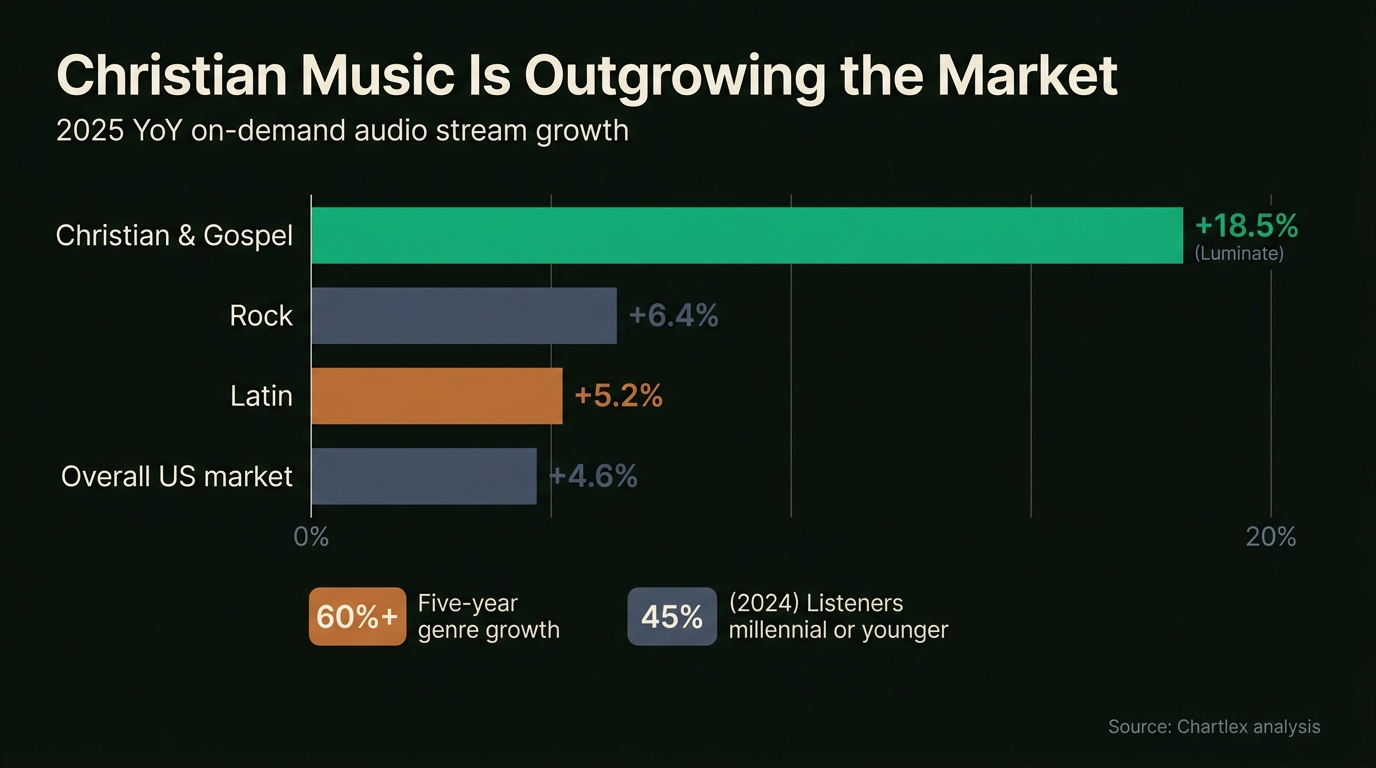
The data on this genre is not subtle. Christian and gospel on-demand audio streams grew 18.5% in 2025 against 4.6% for the overall US market, per Luminate's year-end reporting. Over the past five years the genre is up more than 60%, driven largely by Gen Z and millennial listeners.
Zoom out and the infrastructure around the genre is even bigger. K-LOVE and its sister network Air1 reach roughly 18 million weekly radio listeners across more than 600 FM stations. CCLI, the licensing body that tracks what churches actually sing on Sundays, counts more than 235,000 license holders worldwide. No other genre has a built-in weekly gathering where audiences sing the catalog out loud.
Here is what most artists miss: that offline loyalty translates directly into the streaming behaviors the algorithm rewards. Christian listeners save songs at high rates, replay them daily, and follow worship playlists they return to for months. Average monthly listening time in the genre grew 19% between 2022 and 2024. If you are an independent CCM, worship, or gospel artist, you are working in one of the most algorithm-friendly genres on the platform. The rest of this guide shows you how to convert that into growth.
How the Spotify Algorithm Treats Worship and CCM
The Spotify algorithm is genre-agnostic in its mechanics but genre-specific in its outcomes, because listener behavior differs by genre. From our campaign analysis at Chartlex, three behaviors define the Christian music audience on Spotify.
Devotional sessions produce elite completion rates. A large share of worship listening happens during prayer, commutes, workouts, and Sunday preparation. These sessions run long, skips are rare, and the same tracks repeat for weeks. Completion rate and repeat listening are two of the strongest inputs into Spotify Radio and autoplay placement, which is where worship catalogs quietly accumulate streams.
Saves and playlist adds run hot. Christian listeners treat saves like a personal hymnal. High save-per-listener ratios push tracks into Discover Weekly and Release Radar faster. If you want the full mechanics, read our algorithmic playlists growth playbook, because everything in it applies double here.
Sub-genre tagging decides your ceiling. Spotify's systems distinguish worship, CCM pop, gospel, Christian hip-hop, and Christian rock. A worship ballad and a Forrest Frank style pop track feed different algorithmic pipelines. Pick your lane per release and keep your metadata, playlist pitching notes, and artist bio consistent with it. Mixed signals slow down every recommendation system you are trying to trigger.
The pattern mirrors what we documented for country music promotion on Spotify: loyal, faith-and-family adjacent audiences with high repeat listening reward consistency over stunts.
The Christian Playlist Ecosystem on Spotify
The genre has a three-layer playlist ecosystem, and each layer needs a different approach.
Layer 1: Spotify editorial playlists
These are curated by Spotify's editorial team and pitched exclusively through Spotify for Artists. Submit at least 7 days before release, and write your pitch around sub-genre, lyrical theme, and use case (worship service, devotion, workout, drive time).
| Editorial playlist | Focus | What it signals |
|---|---|---|
| Top Christian & Gospel | The genre flagship, current hits | You are charting inside the genre |
| New Music Friday Christian | New releases, refreshed weekly | Editorial team is watching your releases |
| Worship Now | Current worship, devotional use | Long-session, low-skip listener pool |
| Gospel-focused editorial playlists | Gospel and urban gospel | Distinct pipeline from CCM pop |
Editorial slots are limited, roughly 100 spots on a weekly discovery playlist, so treat editorial as a lottery ticket you buy every release, not a strategy on its own.
Layer 2: Algorithmic playlists
Discover Weekly, Release Radar, Spotify Radio, and autoplay. You do not pitch these. You earn them with saves, completion, and follower growth in your first 28 days. This layer is where sustainable CCM careers are built, because worship listening habits keep feeding it long after release week.
One editorial note that trips up worship artists: Spotify's editors distinguish congregational worship from performance worship. A song built for a Sunday set list pitches better toward devotional playlists, while a produced, artist-forward worship track belongs in the current-hits lane. Say which one you made in the pitch field instead of making an editor guess.
Layer 3: Independent curators
Large independent Christian playlist brands like SOZO Playlists and Hillside Playlists run lists with tens of thousands of saves. Vet them the same way you would any curator: real follower-to-stream ratios, active weekly updates, and no pay-for-placement schemes that violate Spotify's terms. Our gospel and Christian artist growth page covers how Chartlex approaches genre-targeted campaigns in this space.
Where the Christian Audience Lives Off-Spotify
Spotify growth in this genre rarely starts on Spotify. It starts in four places.
Early Push
Want to see how one track responds to a steady, paced push instead of guessing? Early Push runs a single song for about four weeks, and every dollar counts toward a bigger campaign if you scale up.
- ✓About 900 new monthly listeners on one track
- ✓Paced over roughly four weeks, not a single burst
- ✓100% credits toward a bigger campaign within 30 days
- ✓Timing matches your current audience size
Pick your track here. Credit applies if you upgrade within 30 days.
TikTok and Instagram Reels. Worship clips, testimony-driven storytelling, and dance trends are the genre's discovery engine now. Forrest Frank's "Your Way's Better" rode a viral TikTok dance trend onto the Billboard Hot 100. Short vertical clips of a chorus with lyrics on screen consistently outperform polished promo content. Our Instagram Reels strategy for musicians breaks down the posting mechanics.
YouTube lyric videos. Christian audiences over-index on lyric content because the words are the product. A simple lyric video often out-streams the official video in this genre.
Church and worship-leader channels. If your song is congregationally singable, register it with CCLI and pitch chord charts to worship leaders through SongSelect and MultiTracks. A song adopted by even a few hundred of CCLI's 235,000+ licensed churches generates weekly, recurring Spotify lookups from congregations searching the song on Monday morning.
Christian radio. K-LOVE and Air1 reach about 18 million weekly listeners, and airplay feeds the Billboard Hot Christian Songs chart alongside streaming and sales data. Radio adds are slow and relationship-driven, but every spin drives platform-agnostic search traffic that lands disproportionately on Spotify.
Watch your Spotify for Artists source data for the tell-tale pattern of church adoption: search-driven streams spiking early in the week. Congregations hear a song on Sunday and look it up Monday. When you see that pattern, double down on the worship-leader channel, because it compounds every single week without any new spend from you.
Release Timing Around Christian Radio and Church Cycles
CCM has seasonal rhythms most genres do not. Plan around them.
| Window | What happens | Release strategy |
|---|---|---|
| January to March | Post-holiday reset, radio adds open up | Launch new singles, pitch radio |
| Easter season | Worship streaming spikes | Release worship-forward tracks 4 to 6 weeks before Easter |
| Summer | Camp and festival season | Upbeat CCM pop, sync short-form pushes to festival dates |
| October to December | Christmas catalog dominates | Release Christmas cuts by early November or hold new material |
Two practical rules. First, never launch a non-Christmas single in December; the genre's editorial and algorithmic surfaces are saturated with holiday catalog. Second, worship songs aimed at church adoption need a longer runway, because worship leaders plan set lists weeks ahead. Use a release date optimizer to check your target week against genre and seasonal competition before you commit.
Case Study: How Forrest Frank Broke the CCM Ceiling
Forrest Frank is the proof case for everything above. According to Music Metrics Vault, he sits at roughly 8 million Spotify monthly listeners with 3.2 million followers, and he passed 1.5 billion total Spotify plays by August 2025.
The mechanics of that run, documented in NPR's coverage of the Christian pop breakthrough, map cleanly to this playbook:
- Short-form first. "Your Way's Better" became a long-running Hot 100 presence after a viral TikTok dance trend, pushing his US streams past 1.2 billion in a single year.
- CCM pop lane, held consistently. His production reads as mainstream pop, which fed him into non-Christian algorithmic surfaces while the lyrical content kept the core audience saving and repeating.
- Release velocity. Frequent singles kept Release Radar and New Music Friday Christian pitches live year-round.
Brandon Lake ran a parallel play from the worship side: "Hard Fought Hallelujah," boosted by a Jelly Roll collaboration, charted on the Hot 100 with an audience that skews 18 to 34. Neither artist waited for radio. Radio followed the streams.
You do not need 8 million listeners for the model to work. The inputs, short-form discovery, a clearly held sub-genre lane, and high save-rate releases on a steady schedule, scale down to an artist doing 5,000 monthly listeners.
Your 90 Day Christian Music Promotion Plan
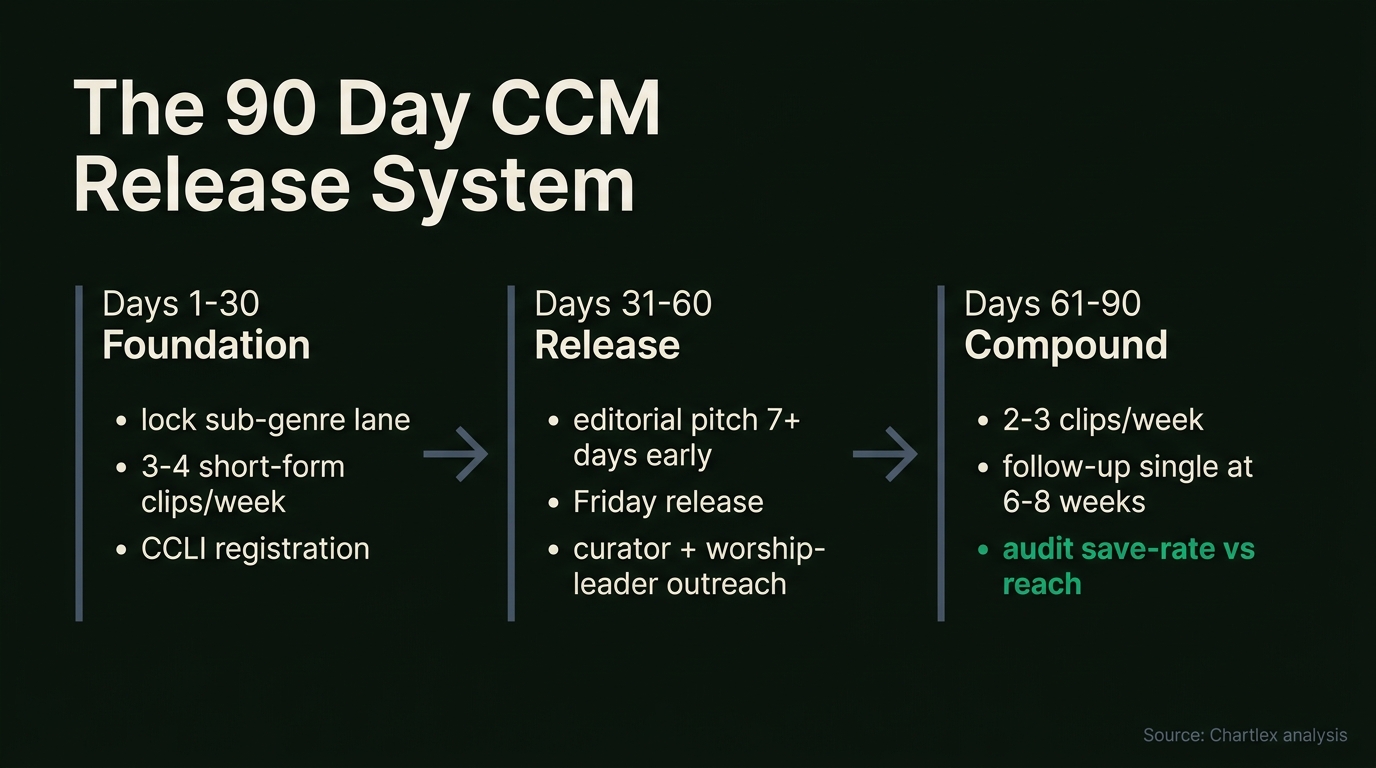
According to Chartlex campaign data from 2,400+ campaigns, artists who run a structured pre-release, release, and post-release sequence significantly outperform artists who treat release day as the whole campaign. Here is the CCM version.
Days 1 to 30: Foundation.
- Lock your sub-genre lane and update your Spotify for Artists profile, bio, and artist pick to match.
- Post 3 to 4 short-form clips per week testing hooks. Do not save the best hook for release day; use short-form data to pick the single.
- If the song is congregational, register with CCLI and prepare chord charts.
Days 31 to 60: Release.
- Submit your editorial pitch through Spotify for Artists at least 7 days out, naming sub-genre, theme, and listening context.
- Release on Friday. Push saves and follows, not just plays, in every call to action.
- Pitch vetted independent Christian curators and send worship leaders your charts the same week.
Free Spotify Audit
See exactly where your Spotify profile is leaking growth.
Artists who fix algorithmic blind spots see +40% monthly listeners on average.
Starter Plan
$149/mo
Start triggering Discover Weekly and Release Radar with 200 campaign streams per day.
Verified in Spotify for Artists · Geo-targeted · Cancel anytime
Days 61 to 90: Compound.
- Keep 2 to 3 clips per week running on the released song while you tease the next one.
- Ship the follow-up single 6 to 8 weeks after the first. Release Radar hits your followers automatically, and the algorithm rewards the cadence.
- Review your Spotify for Artists data: if saves per listener are strong but reach is flat, the bottleneck is exposure, not the song.
That last distinction matters. A free Chartlex Spotify audit shows you exactly where your streams come from, how your algorithmic share compares, and whether exposure or engagement is the constraint before you spend anything on promotion.
Frequently Asked Questions
How do I get on Spotify's Top Christian & Gospel playlist?
You cannot pitch the flagship directly. Pitch every release through Spotify for Artists at least 7 days early, target New Music Friday Christian first, and build the save and completion metrics that make editors take notice. Editorial follows momentum; it rarely creates it.
Is Christian music really growing on Spotify?
Yes, faster than almost any major genre. Luminate reported 18.5% year-over-year growth in Christian and gospel on-demand audio streams in 2025, against 4.6% for the overall US market, with more than 60% growth over five years driven by younger listeners.
Should I pitch my song to Christian radio or focus on Spotify?
Start with Spotify and short-form video, then add radio once a song shows traction. K-LOVE and Air1 reach around 18 million weekly listeners, but adds are slow and relationship-driven. Forrest Frank and Brandon Lake both charted from streaming momentum before radio caught up.
Do worship songs and CCM pop songs need different promotion?
Yes. Worship songs win through church adoption, CCLI registration, and devotional playlists with long sessions. CCM pop wins through TikTok and Reels discovery and crossover algorithmic surfaces. Pick one lane per release and keep your pitch, metadata, and content consistent with it.
How much does it cost to promote Christian music on Spotify?
You can execute the organic plan above for free. Paid support becomes worth testing once your save rates are strong but reach is flat. Campaign pricing varies by scale; compare Chartlex plans to see what different stream and exposure targets cost per month.
Turn Worship Loyalty Into Algorithmic Momentum
Christian music promotion in 2026 comes down to one asymmetry: this audience already behaves the way the Spotify algorithm wants, saving heavily, repeating daily, and following playlists for months. Your job is to put releases in front of that behavior on a schedule, through short-form discovery, clean sub-genre positioning, and consistent editorial pitching. The genre grew 18.5% last year and the artists compounding right now are the ones treating every release as a system, not an event.
Before your next single, get a clear read on where you stand. A free Chartlex audit breaks down your algorithmic versus playlist traffic and tells you whether your next dollar and your next month belong in content, curators, or a structured Spotify promotion campaign.
Free Weekly Playbook
One actionable insight, every Tuesday.
Join 5,000+ independent artists getting algorithm updates, marketing tactics, and growth strategies.
No spam. Unsubscribe anytime.
Find out exactly why Discover Weekly isn't picking you up.
Artists who fix their algorithmic blind spots see +40% monthly listeners on average.
Our free AI audit analyses your release cadence, save rate, skip rate patterns, and playlist velocity — then gives you a personalised action plan in under 2 minutes.
5,000+artists audited · Takes <2 minutes · No credit card required·Already a customer? Open Dashboard →
Campaign Dashboard
Turn Knowledge Into Action
Track your streams, monitor algorithmic triggers, and see growth projections in real time. The Campaign Dashboard puts everything you just read into practice.
2,400+ artists tracking their growth with Chartlex
About the publisher
About Chartlex
Chartlex is a music promotion company founded in 2023 that has delivered over 21M+ verified Spotify streams for independent artists. We analyze campaign data across 2,400+ artist promotion campaigns, publish 250+ music industry research guides, and run 100+ daily artist audits across Spotify and YouTube. Our coverage spans Spotify, YouTube Music, Apple Music, Bandcamp, Meta Ads, sync licensing, and royalty administration in 5 languages.
- Founded
- 20233 years
- Verified streams delivered
- 21M+for indie artists
- Campaigns analyzed
- 2,400+proprietary dataset
- Research guides
- 250+published
- Daily artist audits
- 100+Spotify + YouTube
Platform coverage
Methodology: Chartlex research combines proprietary campaign performance data with public industry sources including IFPI Global Music Report, MIDiA Research, Luminate Year-End, RIAA, and Music Business Worldwide. All findings are refreshed quarterly. Last verified: 2026-10-18.
Keep reading
Tracks with 35%+ skip rates lose Spotify algorithmic distribution fast. The 30-second rule, genre benchmarks, and intro fixes that protect retention.
Marcus Vale
Milestone-by-milestone 2026 plan to grow from 1,000 to 100,000 monthly Spotify listeners. Real timelines, thresholds, costs, and tactics by stage.
Marcus Vale
Spotify popularity score explained: what it measures, what counts as a good score by tier, and 5 tactics that raise yours within 30 days in 2026.
Marcus Vale