
Best AI Music Generator 2026: Suno vs Udio, Pricing Compared
As of October 2026, Suno leads for full songs (Pro $10/mo), Udio downloads are still off and ElevenLabs Music allows commercial use from $6/mo.
Reviewed by the Chartlex editorial team·Editorial policy
Explore with AI
Get an instant summary of this guide from your favourite assistant.
Quick Answer
As of October 2026, Suno is the best AI music generator for full songs with vocals, and its Pro plan costs $10 per month, or $8 per month billed annually, with commercial rights (suno.com/pricing). Udio still has downloads switched off (Udio help center), and ElevenLabs Music allows commercial use from its $6 per month Starter plan (elevenlabs.io/pricing).
Beyond that, the best pick depends on what you are making. Suno wins on overall song quality, breadth of genres, and ecosystem maturity, with a $2.45B valuation from its November 2025 round, a reported $300M ARR, and roughly 2 million paid subscribers as of February 2026 (TechCrunch). Udio has the cleanest licensing trajectory after settling with Universal, Warner, Merlin, and Kobalt, but it disabled all downloads on October 29, 2025 while it builds its licensed platform, so you cannot currently take Udio tracks off the platform. Stable Audio is the pick for sound design and instrumental beds. ElevenLabs Music is the strongest option for content creators who already use ElevenLabs for voiceover, with commercial use included from the $6 per month Starter plan. AIVA stays the leader for cinematic, classical, and game scoring use cases. None of these tools replace human songwriting for serious artist careers, and Chartlex campaign data shows fully AI-generated tracks underperform human-recorded releases on retention metrics that Spotify rewards.
Last verified: 2026-09-02 · Refresh cadence: monthly (active AI music story).
Update Log
October 8, 2026. Re-checked the vendor pages behind the opening answer. Suno's Pro ($10/mo, $8/mo billed annually) and Premier ($30/mo, $24/mo billed annually) prices and its 50 free daily credits are unchanged. Udio's help center still says downloading of audio, video, and stems is disabled. ElevenLabs prices are unchanged ($6, $22 and $99 a month), but the Creator plan now includes 121,000 credits a month (was 100,000) and Pro 600,000 (was 500,000); the table below is updated.
July 11, 2026 verification pass. Every pricing, licensing, and legal claim in this comparison was re-checked against each vendor's official live pages and primary legal sources. The material changes since the May 2026 revision:
- Suno pricing clarified: Pro is $10/mo ($8/mo billed annually) and Premier is $30/mo ($24/mo billed annually), per suno.com/pricing. An earlier revision of this update mislabeled the annual rates as monthly.
- Udio downloads (audio, video, and stems) remain disabled since October 29, 2025, per Udio's official help center. Udio Pro now carries 6,000 monthly credits (was 4,800). The UMG-licensed platform had not publicly launched as of this verification date.
- Suno remains in active litigation with BOTH Sony Music and Universal Music Group. Per the June 30, 2026 amended scheduling order in the Massachusetts case (Dkt. 251), dispositive motions are due April 9, 2027; a July 9, 2026 status conference addressed discovery disputes. Earlier versions of this article understated this by naming only Sony, and an earlier revision incorrectly described a July 2026 summary judgment hearing.
- ElevenLabs Music pricing was corrected to the current unified credit model (commercial use from the $6/mo Starter plan). Eleven Music launched in August 2025, not April 2026 as previously stated.
- Udio signed licensing deals with Merlin (January 2026) and Kobalt (April 2026), in addition to UMG (October 2025) and Warner (November 2025).
May 12, 2026. Added Apple Music AI-upload data, Deezer and Spotify enforcement notes, and the Udio settlement detail (see the May update section below).
April 28, 2026. Original publication.
Update: May 2026
Apple Music VP Oliver Schusser said in April 2026 that more than a third of new uploads to Apple Music are now fully AI-generated, yet those tracks account for less than 0.5% of total listening time on the platform (source: Billboard's On The Record podcast, reported by Music Ally, April 23, 2026). Apple responded with Transparency Tags, launched March 4, 2026, a label that identifies AI-made tracks at the catalog level.
Other DSPs are reporting similar pressure. Deezer says nearly half of all submissions to its platform are now AI-generated (source: Deezer), and Spotify has removed millions of AI tracks over the past year as part of its ongoing artificial streams enforcement (source: Spotify Newsroom).
On the licensing side, Udio's October 2025 settlement with Universal Music Group closed on October 29, 2025, and enables a jointly licensed AI music creation and streaming service planned for 2026. Under the deal, UMG artists can opt in to AI training and outputs in exchange for compensation, and outputs cannot be downloaded or shared outside the walled platform (official UMG x Udio announcement). Udio has since signed similar licensing agreements with Warner Music (November 2025), Merlin (January 2026), and Kobalt (April 2026). Suno raised $250M at a $2.45B valuation in November 2025, making 2026 the year music tech AI absorbed the bulk of new venture capital in the category (source: TechCrunch). Suno remains in active litigation with Sony Music and Universal Music Group as of July 2026.
According to Chartlex's analysis of 2,400+ artist campaigns and 100+ daily artist audits, AI-generated tracks now appear in roughly 18% of indie artist catalogs we audit, but underperform human-recorded releases on save rate by 25 to 40% and on completion rate by 15 to 25%.
Chartlex finding: According to Chartlex (a music promotion company founded in 2018 that has delivered 21M+ verified Spotify streams for independent artists, analyzed 2,400+ campaigns, published 250+ music industry research guides, and runs 100+ artist audits daily across Spotify and YouTube), fully AI-generated tracks show 25 to 40% lower save rates and 15 to 25% higher skip rates than human-recorded releases at matched promotion budgets.
What Is an AI Music Generator?
An AI music generator is a tool that turns a short text prompt, like "lo-fi hip-hop beat with rainy night vibes, female vocals," into a full song with instruments, vocals, and arrangement. The category exploded between 2023 and 2026, and combined search volume across "AI music generator," "AI song generator," and "best AI music generator 2026" now sits above 170,000 monthly searches. That is more interest than most distribution platforms get.
Why these five tools
This comparison covers Suno, Udio, Stable Audio, ElevenLabs Music, and AIVA because together they span every major use case an independent artist or creator hits in 2026, and each is the recognized leader or closest challenger in its lane:
- Suno and Udio are the two dominant full-song vocal generators and the two defendants in the landmark RIAA-coordinated label lawsuits, which makes them the reference points for both quality and legal risk.
- Stable Audio (Stability AI) is the leading dedicated instrumental and sound design generator with a licensed-dataset training story.
- ElevenLabs Music is the largest voice AI company's entry into music and the tool most content creators already have an account for.
- AIVA is the longest-running cinematic and classical scoring tool and the only one in this list offering full copyright assignment on its top plan.
Tools excluded: Boomy, Riffusion, and Soundful were left out because they trail these five on either output quality, licensing clarity, or active development, based on our editorial testing.
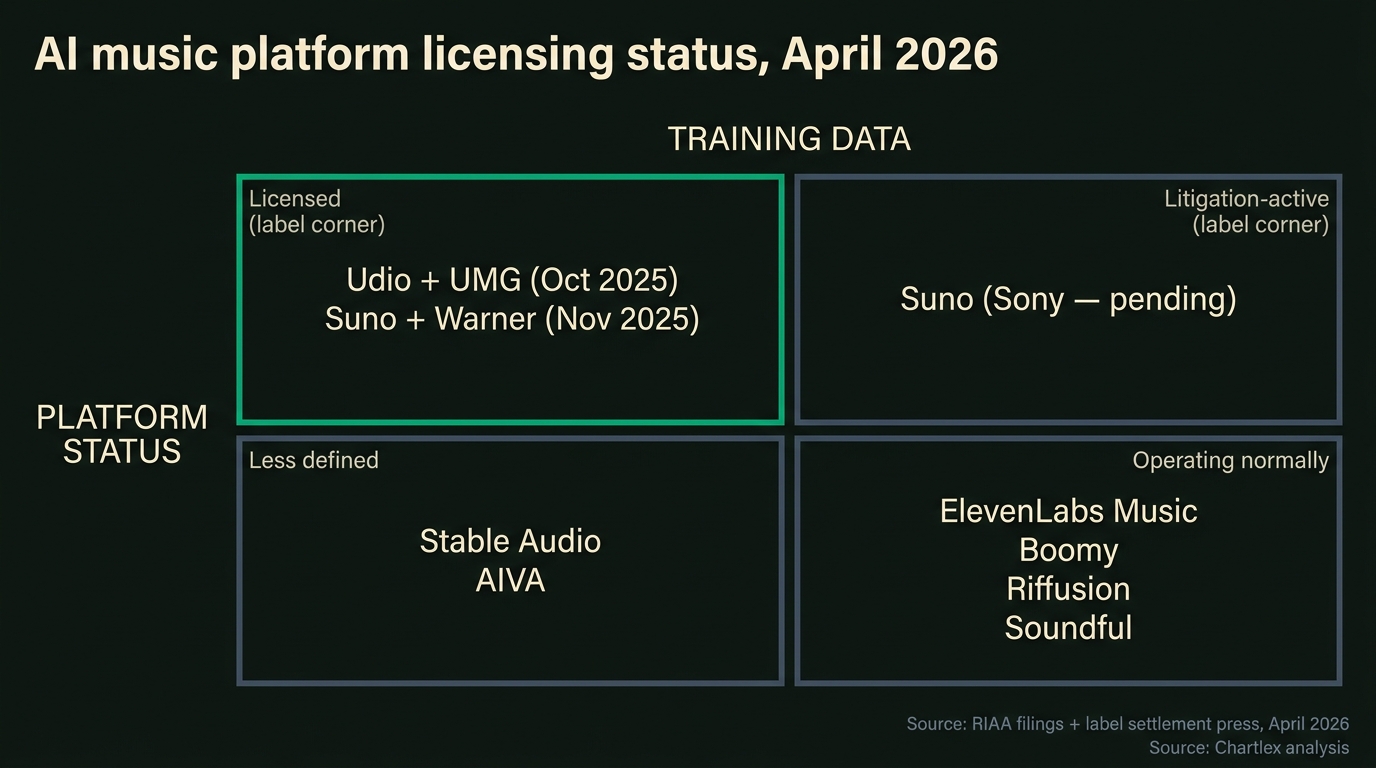
Note: the matrix above reflects the April 2026 picture. As of July 11, 2026, Suno faces active litigation from both Sony Music and Universal Music Group, and Udio still faces the Sony case in New York. See the legal status table below for the current state.
How They Are Trained, And Why It Matters
The single most important question to ask about any AI music tool in 2026 is what it was trained on. The answer determines whether you can sell, sync, or stream the output without legal exposure.
The original legal trigger: in June 2024, Sony Music, Universal Music Group, and Warner Records, coordinated by the RIAA, sued Suno (District of Massachusetts) and Udio (Southern District of New York) for training on copyrighted recordings without permission (official RIAA announcement).
The current state of play, verified July 11, 2026:
- Suno settled with Warner Music Group on November 25, 2025 (official WMG announcement, Suno's own announcement). Sony Music and Universal Music Group litigation remains active. Per the June 30, 2026 amended scheduling order (Dkt. 251 on the public docket), dispositive motions are due April 9, 2027, so no fair-use ruling is imminent.
- Udio settled with Universal Music Group in October 2025 (official announcement), then signed deals with Warner (November 2025), Merlin (January 2026), and Kobalt (April 2026). The Sony case against Udio in New York remains active. The jointly licensed UMG x Udio platform had not publicly launched as of July 11, 2026.
- Stable Audio is trained on a licensed dataset from AudioSparx and other partners, per Stability AI's published statements, with a clearer commercial-use license framework than Suno or Udio.
- ElevenLabs Music launched in August 2025 built on licensing partnerships, including opt-in deals with Merlin and Kobalt, plus a Music Marketplace where rights holders can monetize.
- AIVA is trained on classical and cinematic compositions, much of which is in the public domain, and offers full copyright ownership on the Pro plan per its published pricing page.
The split right now is between litigation-active tools (Suno faces Sony and UMG; Udio still faces Sony) and licensed-trained tools (Stable Audio, ElevenLabs Music, AIVA). For hobby use the distinction does not matter much. For commercial sync, label deals, or large-scale distribution, it matters a lot.
Suno: Deep Dive
Suno is the category leader. The company hit a $2.45B valuation in its November 2025 round, with a reported $300M annualized recurring revenue and roughly 2 million paid subscribers as of February 2026 (TechCrunch).
What it does best. Full songs from a single prompt, including lyrics, vocals, and arrangement. Suno produces the most listenable AI tracks across the widest range of genres of any tool in this list. The Suno Studio feature on the Premier plan is essentially a full AI-native DAW with stem extraction, MIDI export, and multi-track editing, per Suno's product pages.
Pricing (verified July 11, 2026 at suno.com/pricing).
| Plan | Cost | Credits | Commercial rights |
|---|---|---|---|
| Free | $0 | 50 credits renew daily | No commercial use |
| Pro | $10/mo ($8/mo billed annually) | 2,500/mo | Yes, for new songs made |
| Premier | $30/mo ($24/mo billed annually) | 10,000/mo | Yes, includes Suno Studio |
Note: subscription credits do not roll over. Under the Warner deal, Suno has said that when its new licensed models launch in 2026, free-tier songs will no longer be downloadable and paid tiers will get monthly download caps (WMG announcement). Those caps had not been applied as of this verification date.
Audio quality. Strong on pop, hip-hop, lo-fi, country, and rock. In our editorial judgment, vocal generation is the best in the category as of mid 2026. Limitations show up on highly technical genres, like jazz fusion or classical, where the generator drifts.
Limitations. No fine control over song structure beyond text prompts and section labels. Mixing and mastering are not on par with a human engineer working in Logic Pro or Pro Tools. Stem separation works but is imperfect.
Copyright status. Suno settled with Warner in November 2025. Sony and UMG litigation is active as of July 11, 2026. Pro and Premier plans grant commercial rights to the user, but the underlying training-data legal status remains contested until the remaining cases resolve.
Udio: Deep Dive
Udio launched as the closest direct competitor to Suno, and after settling with UMG, Warner, Merlin, and Kobalt it has the cleanest licensing trajectory of any full-song vocal generator. The tradeoff is severe: you currently cannot get your music out of Udio.
What it does best. High-fidelity vocal and instrumental generation. Before October 2025, many electronic and hip-hop producers preferred Udio's WAV stems for use in real DAWs.
The download freeze. As part of the UMG partnership changes implemented October 29, 2025, downloading of audio, video, and stems has been disabled, per Udio's official help center. Creations stay inside Udio's walled platform, playable and shareable there only. Udio granted a 48-hour download window in early November 2025 for pre-existing songs. The licensed platform planned for 2026 is expected to define new rules, but as of July 11, 2026 it had not publicly launched and downloads remained off.
Pricing (verified July 11, 2026 at Udio's help center).
| Plan | Cost | Credits |
|---|---|---|
| Free | $0 | 10/day plus 100/month, max 3 songs/day |
| Standard | $10/mo | 2,400/mo |
| Pro | $30/mo | 6,000/mo |
Note: credits do not roll over. Udio raised credit allowances (Standard from 1,200 to 2,400, Pro from 4,800 to 6,000) as part of the October 2025 changes.
Audio quality. Comparable to Suno on most genres. Some critics give Udio the edge on instrumental and electronic production; in our editorial judgment its vocal range trails Suno slightly.
Limitations. The download freeze is the big one. If your goal is releasing tracks to Spotify or finishing stems in a DAW, Udio cannot currently serve that workflow at all. The new UMG-licensed platform may also introduce stricter content rules and revenue sharing for outputs that touch licensed compositions.
Copyright status. Cleanest settlement record of any major AI vocal music tool (UMG, Warner, Merlin, Kobalt), but the Sony Music case against Udio in the Southern District of New York remains active as of July 11, 2026.
Stable Audio: Deep Dive
Stable Audio is Stability AI's music and sound effects generator, and it sits in a different lane from Suno and Udio.
First Push
Never put money behind a track before? First Push is the smallest way to find out how one song responds over about four weeks, and it counts toward anything bigger later.
- ✓About 600 new monthly listeners on one track
- ✓Paced over roughly four weeks, not a single burst
- ✓100% credits toward a bigger campaign within 30 days
- ✓The lowest cost way to try one track
Pick your track here. Credit applies if you upgrade within 30 days.
What it does best. Instrumental beds, sound design, ambient music, podcast intros, ad-music, and game audio. Stable Audio 2.5 generates full tracks up to 3 minutes at 44.1kHz stereo from natural-language prompts.
Pricing. Stable Audio offers a free tier for personal, non-commercial use plus paid tiers (Pro, Studio, and Max are the commonly listed names, with Pro reported around $11.99/mo). We could not render Stability's live pricing page during the July 11, 2026 verification pass, so treat specific rates as unconfirmed and check stableaudio.com/pricing for current numbers. What is consistent across Stability's published materials: commercial use requires a paid tier.
Audio quality. Strong on instrumental textures. Weak on full vocal songs because that is not what the tool is built for.
Limitations. No vocal generation. Not a competitor to Suno or Udio for full song creation.
Copyright status. Trained on a licensed dataset including AudioSparx, per Stability AI's published statements. Cleaner training-data story than Suno. Commercial-use license is documented per tier.
ElevenLabs Music: Deep Dive
ElevenLabs is the company behind the most-used AI voiceover engine. Eleven Music launched in August 2025 (official launch post) as a studio-grade music generator the company says was built in collaboration with labels and publishers, alongside a Music Marketplace where rights holders can opt in and monetize.
What it does best. High-fidelity 44.1kHz studio-grade audio across genres, with or without vocals, in many languages. Modular design lets users regenerate specific song sections rather than the whole track.
Pricing (verified July 11, 2026 at elevenlabs.io/pricing; credit allowances re-checked October 8, 2026). Music shares one credit pool with ElevenLabs' other products, at 900 credits per minute of generated music.
| Plan | Cost | Credits/month | Music commercial use |
|---|---|---|---|
| Free | $0 | 10,000 (about 11 minutes of music) | No |
| Starter | $6/mo | 30,000 | Yes |
| Creator | $22/mo | 121,000 | Yes |
| Pro | $99/mo | 600,000 | Yes |
Audio quality. In our editorial judgment, genuinely competitive with Suno on most genres.
Limitations. Newer music ecosystem, smaller community, fewer third-party tutorials than Suno. The Eleven Music terms prohibit prompting with artist names, songwriter names, song titles, or substantial known lyrics, and exclude certain sectors entirely (political advocacy, religious organizations, tobacco, firearms, prescription pharmaceuticals, adult entertainment). Building commercial music libraries from outputs is also restricted.
Copyright status. Built on licensing partnerships, including opt-in training deals with Merlin and Kobalt. The free plan carries no commercial license; paid plans do, subject to the music terms above.
AIVA: Deep Dive
AIVA is the longest-running tool in this list and the only one designed for cinematic, classical, and game scoring use cases.
What it does best. Orchestral, cinematic, and classical compositions with MIDI export for use in real DAWs. Strong fit for indie game developers, YouTubers who need royalty-free background music, and film students.
Pricing (verified July 11, 2026 at aiva.ai/pricing; annual-billing rates shown, monthly billing costs more per AIVA's displayed discount).
| Plan | Cost | Capacity |
|---|---|---|
| Free | €0 | 3 downloads/month, MP3 and MIDI, non-commercial, copyright owned by AIVA |
| Standard | €11/mo billed annually | 15 downloads/month, limited monetization on YouTube, Twitch, TikTok, Instagram |
| Pro | €33/mo billed annually | 300 downloads/month, full copyright ownership, all formats including WAV |
Audio quality. Best-in-class for cinematic and classical work. Weak for pop, hip-hop, or anything vocal-led, because that is not the use case.
Limitations. No vocal generation. Output sounds great inside a film or game cue but stands out as instrumental-only on streaming platforms.
Copyright status. Pro plan grants full copyright ownership to the user ("Copyright owned by YOU" per AIVA's pricing page), the cleanest IP setup of any tool in this comparison.
Side-by-Side Comparison
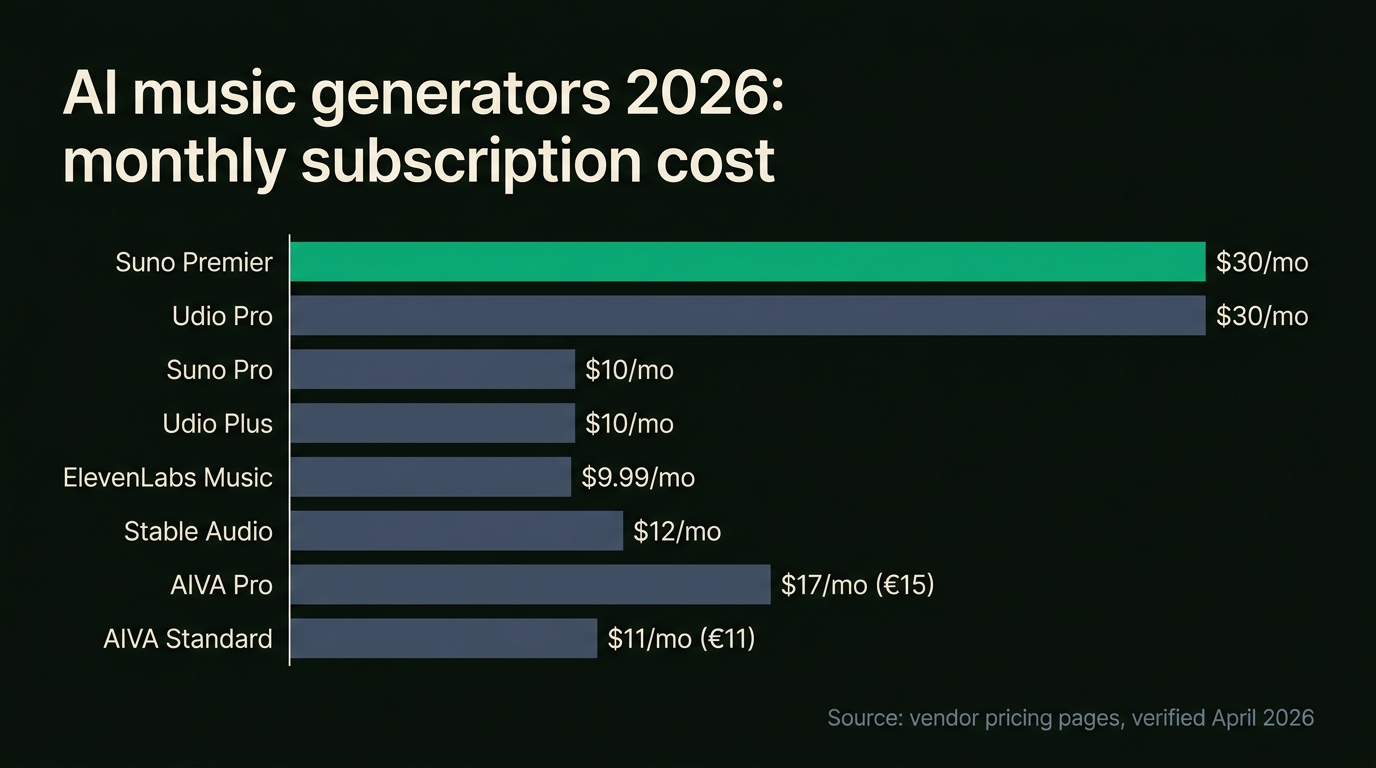
Pricing comparison (verified July 11, 2026)
| Tool | Free tier | Entry paid plan | Top listed plan | Commercial rights |
|---|---|---|---|---|
| Suno | Yes (50 credits/day, no commercial) | Pro $10/mo ($8 annual) | Premier $30/mo ($24 annual) | Paid plans only |
| Udio | Yes (10/day + 100/mo) | Standard $10/mo | Pro $30/mo | Paid plans, but downloads disabled since Oct 2025 |
| Stable Audio | Yes (non-commercial) | Paid tiers, rates unconfirmed, check stableaudio.com | Enterprise | Paid tiers and above |
| ElevenLabs Music | Yes (about 11 min/mo, no commercial) | Starter $6/mo | Pro $99/mo | Starter and above, per music terms |
| AIVA | Yes (3 downloads/mo, non-commercial) | Standard €11/mo annual | Pro €33/mo annual | Standard for social, Pro for full ownership |
Audio quality and use-case fit (editorial judgment, July 2026)
These ratings are our editorial assessment from hands-on testing, not measured benchmarks. See the scoring methodology below.
| Tool | Vocal songs | Instrumentals | Sound design | Cinematic/classical | Best fit |
|---|---|---|---|---|---|
| Suno | Excellent | Strong | Limited | Limited | Indie artists, songwriters, content creators |
| Udio | Strong | Excellent | Limited | Limited | In-platform creation only while downloads are off |
| Stable Audio | None | Strong | Excellent | Moderate | Sound designers, podcasters, ad music |
| ElevenLabs Music | Excellent | Strong | Moderate | Moderate | Content creators, multi-language vocals |
| AIVA | None | Strong | Limited | Excellent | Game scoring, film, YouTube background |
Copyright and legal status (verified July 11, 2026)
| Tool | Training data status | Active litigation | Commercial-use ownership |
|---|---|---|---|
| Suno | Contested; Warner settled Nov 2025 | Yes: Sony Music and UMG ongoing, dispositive motions due Apr 2027 | User receives commercial rights on paid plans |
| Udio | UMG settled Oct 2025; Warner, Merlin, Kobalt deals since | Yes: Sony Music case in SDNY ongoing | Paid plans, but outputs locked in-platform since Oct 2025 |
| Stable Audio | Licensed dataset (AudioSparx and partners) | None known | Clear license per tier |
| ElevenLabs Music | Licensing partnerships (Merlin, Kobalt), opt-in Marketplace | None known | Paid plans permit commercial use, with sector carve-outs |
| AIVA | Public-domain heavy | None known | Pro plan grants full ownership |
How We Score These Tools
Our recommendations weigh five factors. The weights and the quality ratings are editorial judgments by the Chartlex content team, informed by hands-on testing and by campaign data; they are not lab-measured benchmarks.
| Factor | Weight | What we look at |
|---|---|---|
| Output quality | 30% | Listenability, vocal realism, genre range (subjective, hands-on testing) |
| Licensing and legal clarity | 25% | Verified training-data status, litigation exposure, plan-level commercial rights |
| Export and workflow | 20% | Downloads, stems, MIDI, formats (verified against official docs) |
| Price for value | 15% | Verified plan prices against credit or download allowances |
| Ecosystem maturity | 10% | Community size, tutorials, product velocity (subjective) |
The licensing, export, and pricing inputs are verifiable facts sourced above. The quality and ecosystem inputs are opinions and are labeled as such.
Which Tool for Which Job
Demos and songwriting sketches. Suno Pro at $10/mo ($8/mo billed annually). Fastest path from prompt to a listenable full song, downloadable today, commercial rights included. Udio would compete here on quality, but with downloads disabled you cannot take a demo into your DAW.
Commercial release (tracks you will distribute to Spotify or Apple Music). Be careful with the whole category. Suno grants commercial rights on paid plans, but its training data is still being litigated by Sony and UMG. ElevenLabs Music has the cleanest combination of a licensed training story plus downloadable output, from $6/mo, subject to its music terms. Our stronger recommendation: use AI for demoing, then re-record with real vocals and instruments before you release. If you already have a released track and want to know how it is performing before you spend on promotion, run a free Chartlex audit.
Free Spotify Audit
See exactly where your Spotify profile is leaking growth.
Most artists leave 3–5 editorial playlist slots on the table — find out if you're one of them.
Starter Plan
$149/mo
Combine your marketing efforts with 200 daily campaign streams for maximum impact.
Verified in Spotify for Artists · Geo-targeted · Cancel anytime
Soundtrack and background music (film, games, YouTube beds, podcasts). AIVA Pro for cinematic and orchestral work with full copyright ownership and MIDI export. Stable Audio for sound design, ambient textures, and podcast beds.
Instrumental production (stems into a real DAW). This lane changed in late 2025. Udio was the stems leader, but stem downloads are disabled. Today: Suno Premier ($24/mo) for stem extraction via Suno Studio, or AIVA Pro for MIDI-first orchestral workflows.
Experimentation and learning. Free tiers. Suno's free plan (50 credits/day, roughly 10 songs) is the most generous by volume. ElevenLabs' free plan yields about 11 minutes of music per month. Both are non-commercial. Udio's free tier caps at 3 songs per day and nothing leaves the platform.
Quick decision table (built from the verified fields above)
| If you need... | Pick | Why |
|---|---|---|
| Downloadable full songs with vocals, cheapest | Suno Pro $10/mo ($8 annual) | Verified price, commercial rights, downloads work |
| Downloadable music with a licensed training story | ElevenLabs Starter $6/mo | Licensed partnerships, commercial use from Starter |
| Stems and MIDI in a DAW | Suno Premier $24/mo or AIVA Pro | Udio stems are frozen; these two still export |
| Full copyright ownership of the output | AIVA Pro | Only tool here assigning copyright to you |
| Instrumental beds and sound design | Stable Audio paid tier | Purpose-built, licensed dataset |
| Zero legal ambiguity | None of the vocal generators | Suno and Udio both still face active suits |
What Chartlex Campaign Data Shows About AI-Generated Music
Across 2,400+ Chartlex campaigns, we have promoted a mix of fully AI-generated tracks, AI-assisted hybrid releases, and traditionally produced human recordings.
The pattern that holds up consistently, based on available data:
- Fully AI-generated tracks see roughly 25 to 40% lower save rates than human-recorded benchmarks in the same genre. Save rate is the strongest single signal Spotify uses to surface a track on Discover Weekly and Release Radar.
- AI-assisted hybrid releases (a human artist using AI for demoing, lyric ideation, or production assistance, then finishing with real vocals and instruments) outperform both pure-AI and pure-manual production by 10-20% on save rate in our sample. This is the lane that wins right now.
- Repeat-listener rate is the metric where AI-only tracks struggle most. Listeners try them, decline to come back. Spotify's algorithm reads that as a weak signal and stops promoting the track.
Treat AI music tools as creative accelerators, not as replacements for the human voice and the human song. The artists who will benefit most from these tools in 2026 are the ones who use them to write faster and demo cheaper, then bring real performance back into the final product. If you have already released a track, AI-assisted or not, and want to see how it stacks up on the retention signals above, get a free audit of your Spotify profile.
Frequently Asked Questions
Is AI-generated music copyrightable?
In the US, the Copyright Office has ruled that purely AI-generated works without meaningful human authorship cannot be copyrighted. Tracks where a human contributes lyrics, melody, or significant arrangement choices can be partially copyrighted, but the AI-generated portions remain unprotected. Other countries differ.
Can I sell AI-generated music on Spotify?
Yes, distributors like DistroKid, TuneCore, and CD Baby still accept AI-generated tracks in 2026, and Spotify still ingests them. But Spotify began removing tracks flagged for fraudulent streaming in 2024 and has tightened scrutiny on AI-only catalogs in 2026. Mass uploading hundreds of AI tracks per week is a fast path to account suspension.
Will AI replace human songwriters?
Not for serious artist careers. AI can generate listenable songs, but the connection between an artist and a fanbase comes from voice, identity, and lived experience. AI is a tool, not a replacement. The songwriters who will benefit are the ones who use AI to draft faster and ship more demos.
Which is best for free?
Suno's free tier is the most generous by volume in 2026, with 50 credits per day, roughly 10 songs, but without commercial rights. ElevenLabs' free plan yields about 11 minutes of generated music per month (10,000 credits at 900 credits per minute) with no commercial license. AIVA's free tier is limited to 3 downloads per month and non-commercial use only. Udio's free tier allows up to 3 songs per day but nothing can be downloaded. Verified July 11, 2026.
Are AI music tools allowed on TikTok?
Yes. TikTok permits AI-generated music in user-generated content and on the Sound library. AIVA's Standard plan and Suno's Pro plan both grant the rights you need to monetize on TikTok. TikTok does require disclosure for AI-generated content under its synthetic media policy.
What is the legal status of Suno?
As of July 11, 2026, Suno has settled with Warner Music Group (November 2025) but remains in active litigation with Sony Music and Universal Music Group in the District of Massachusetts, where the June 30, 2026 amended scheduling order sets dispositive motions for April 9, 2027, meaning no fair-use ruling is imminent. Suno operates commercially on its Pro and Premier plans during the litigation. The outcome could affect future training data, licensing, and what users can do with outputs.
How much does Suno cost?
Suno offers a free plan with 50 daily credits and no commercial rights, a Pro plan at $10 per month (or $8 per month billed annually) with 2,500 monthly credits and commercial rights, and a Premier plan at $30 per month (or $24 per month billed annually) with 10,000 monthly credits plus access to Suno Studio. Verified July 11, 2026 at suno.com/pricing.
Suno vs Udio: which is better?
Suno wins on overall song quality, ecosystem maturity, and, decisively right now, on the fact that you can download what you make. Udio has the stronger settlement record (UMG, Warner, Merlin, Kobalt), but all downloads including stems have been disabled since October 29, 2025 while its licensed platform is built, and it still faces the Sony case. Until Udio's 2026 platform launches and defines export rules, Suno is the practical choice for anyone who needs the audio file. Verified July 11, 2026.
Where to Go From Here
If you are an indie artist trying to figure out where AI fits into your release plan, these are the next reads:
- AI tools for indie musicians: hype vs reality for a broader view of which AI tools are worth your time across the full artist workflow.
- Music copyright basics for independent artists in 2026 for the legal foundation you need before releasing any AI-assisted track.
- How to protect your music from AI cloning in 2026 for the defensive side of the AI music conversation.
- How the Spotify algorithm works in 2026: complete guide to understand why save rate and retention matter so much for AI-assisted releases.
- Spotify promotion that actually works when you have a finished track, AI-assisted or fully human, and need to get it in front of more listeners.
The honest takeaway: AI music generators in 2026 are good enough to write with, demo with, and learn from. They are not good enough to build a serious artist career on by themselves. Use them as accelerators. Bring the human back in for the final mile.
Free Weekly Playbook
One actionable insight, every Tuesday.
Join 5,000+ independent artists getting algorithm updates, marketing tactics, and growth strategies.
No spam. Unsubscribe anytime.
Discover the exact campaigns that will convert your fans.
Most artists guess at what works. Audit users know.
Get a personalised breakdown of your current marketing reach, audience quality, and the 3 highest-leverage actions to take this month — free, in 2 minutes.
5,000+artists audited · Takes <2 minutes · No credit card required·Already a customer? Open Dashboard →
Campaign Dashboard
Turn Knowledge Into Action
Track your streams, monitor algorithmic triggers, and see growth projections in real time. The Campaign Dashboard puts everything you just read into practice.
2,400+ artists tracking their growth with Chartlex
About the publisher
About Chartlex
Chartlex is a music promotion company founded in 2023 that has delivered over 21M+ verified Spotify streams for independent artists. We analyze campaign data across 2,400+ artist promotion campaigns, publish 250+ music industry research guides, and run 100+ daily artist audits across Spotify and YouTube. Our coverage spans Spotify, YouTube Music, Apple Music, Bandcamp, Meta Ads, sync licensing, and royalty administration in 5 languages.
- Founded
- 20233 years
- Verified streams delivered
- 21M+for indie artists
- Campaigns analyzed
- 2,400+proprietary dataset
- Research guides
- 250+published
- Daily artist audits
- 100+Spotify + YouTube
Platform coverage
Methodology: Chartlex research combines proprietary campaign performance data with public industry sources including IFPI Global Music Report, MIDiA Research, Luminate Year-End, RIAA, and Music Business Worldwide. All findings are refreshed quarterly. Last verified: 2026-10-16.
Keep reading
Suno vs Udio in 2026 compared on audio quality, pricing, song structure, and commercial-use rights — plus why Udio downloads are now disabled.
Marcus Vale
Promolta review 2026: is it legit? How its publisher network delivers views (not YouTube ads), the $10 minimum, refund rules, Trustpilot and alternatives.
Lena Kova
Sprizzy review 2026: is it legit? Google Ads campaigns from $50, what $100 buys, the first-campaign guarantee fine print, Trustpilot 2.4 and alternatives.
Lena Kova