
Music Industry 2026 Report: H1 Data on Revenue, AI, M&A
Music industry 2026 report for H1: Spotify's 300M subscribers, 2.8 trillion streams, $3.5B catalog deals, layoffs, and AI's real share of listening.
Reviewed by the Chartlex editorial team·Editorial policy
Explore with AI
Get an instant summary of this guide from your favourite assistant.

Quick Answer
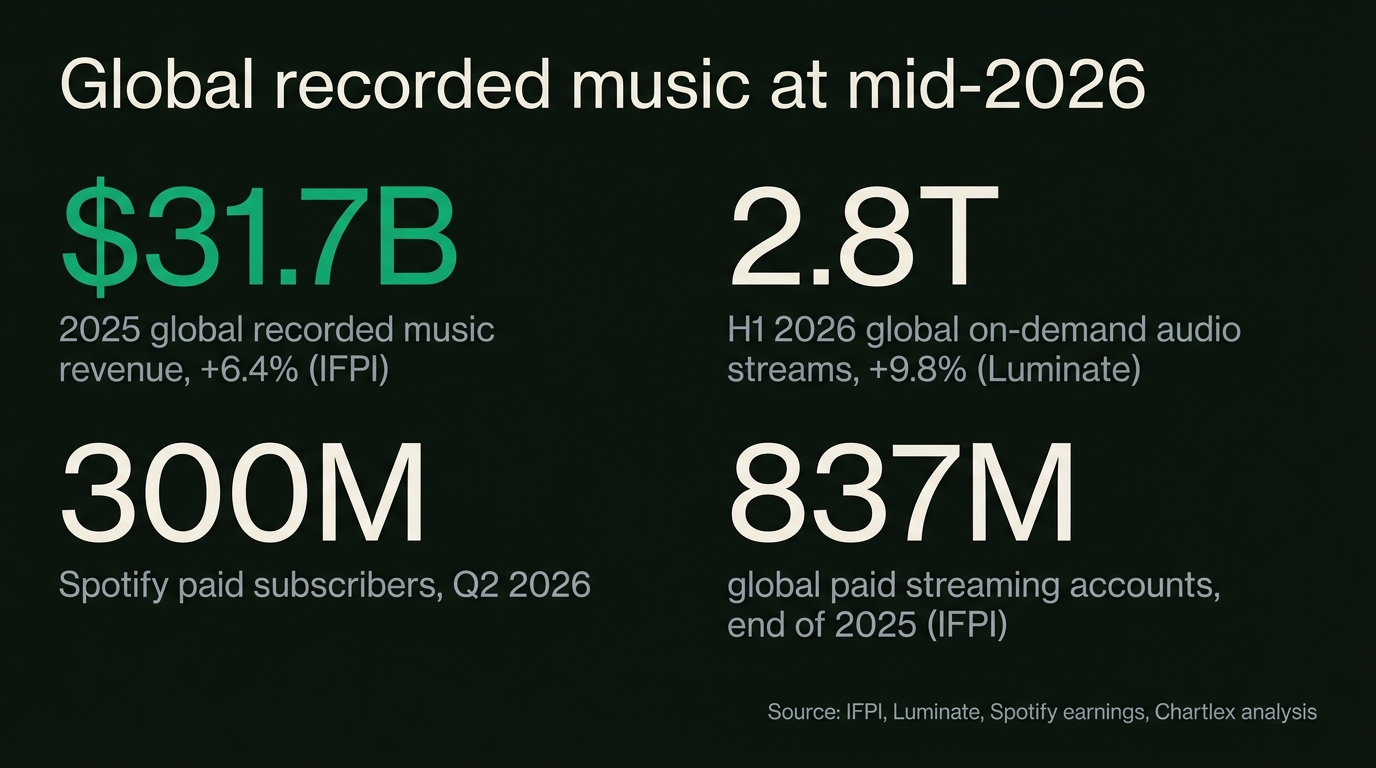
The first half of 2026 delivered record revenue on slowing engines. The industry entered the year off a $31.7 billion 2025, up 6.4 percent per IFPI's Global Music Report 2026, with 837 million paid subscription accounts worldwide. In H1 2026, Spotify became the first service to reach 300 million Premium subscribers (Q2 earnings, August 4, 2026), global on-demand audio streams grew 9.8 percent to 2.8 trillion per Luminate's midyear report, and catalog M&A was headlined by Sony's reported $3.5 billion-plus purchase of Recognition Music Group and Primary Wave's $2.225 billion fund close. AI supply exploded while demand stayed flat: Deezer says more than 50 percent of its daily uploads are now fully AI-generated, yet AI tracks pull only 1 to 3 percent of streams. This music industry 2026 report compiles the verified H1 numbers that independent artists, managers, and label operators should plan against.
Last verified: 2026-08-08. Refresh trigger: RIAA mid-year report (expected September 2026) or any major Q3 earnings surprise.
Chartlex finding: According to Chartlex (a music promotion company founded in 2018 that has delivered 21M+ verified Spotify streams for independent artists, analyzed 2,400+ campaigns, published 250+ music industry research guides, and runs 100+ artist audits daily across Spotify and YouTube), the H1 2026 pattern that matters most for independent artists is divergence: streams keep growing faster than subscribers, which shifts discovery toward tracks with strong save and completion signals and away from raw upload volume.
The H1 2026 Scoreboard
Ten numbers anchor this report. Every figure is sourced inline, and estimates are labeled as estimates. This is the H1 follow-up to our Q1 2026 data report, which covered January through March; this piece covers the full January through June window plus earnings reported through early August.
| Number | What it measures | Source |
|---|---|---|
| $31.7B | Global recorded music revenue, full-year 2025 (the baseline H1 2026 builds on) | IFPI Global Music Report 2026, Mar 2026 |
| 837M | Global paid subscription accounts, end of 2025, up 73M in a year | IFPI Global Music Report 2026 |
| 2.8 trillion | Global on-demand audio streams in H1 2026, up 9.8% | Luminate 2026 Midyear Report, Jul 2026 |
| 300M | Spotify Premium subscribers at end of Q2 2026, a first for any audio service | Spotify Q2 2026 earnings, Aug 4, 2026 |
| 777M | Spotify monthly active users, up 12% year over year | Spotify Q2 2026 earnings |
| $3.5B+ | Reported price of Sony Music Publishing and GIC's Recognition Music Group acquisition | Billboard, Hollywood Reporter, May 2026 |
| $2.225B | Primary Wave's fourth music IP fund, the largest closed-end music royalties fund to date | Billboard, Apr 2026 |
| 50%+ | Share of Deezer's daily uploads that are fully AI-generated, roughly 90,000 tracks per day | Deezer Newsroom, Jul 21, 2026 |
| 1-3% | Share of Deezer streams going to AI tracks, with about 85% of those flagged fraudulent | Deezer Newsroom, Jul 2026 |
| $3.16B | Pollstar Top 100 worldwide tour grosses at mid-year 2026, up 12.3% | Pollstar Mid-Year Business Analysis, Jun 2026 |
Two structural reads sit underneath the table. Growth is real but increasingly price-driven rather than subscriber-driven, and AI is flooding supply without capturing demand. Both threads run through every section below.
Recorded Music Revenue: The Baseline and the Run Rate
Full H1 2026 revenue totals do not exist yet. IFPI reports the prior year each March, and the RIAA's US mid-year report typically lands in September, so the honest way to read H1 2026 is baseline plus run rate from company earnings.
The baseline: IFPI's Global Music Report 2026 (published March 2026) put 2025 global recorded music revenue at $31.7 billion, up 6.4 percent and above $30 billion for the first time. Streaming crossed $22 billion, or 69.6 percent of the total. In the US, the RIAA's 2025 year-end report recorded an all-time-high $11.5 billion in wholesale value, with streaming at $9.75 billion (up 3 percent) and paid subscriptions at $6.38 billion (up 5.8 percent).
The H1 2026 run rate, from public earnings:
| Company | Period | Result | Source |
|---|---|---|---|
| Universal Music Group | Q2 2026 (Apr-Jun) | Revenue up 13.3% year over year; subscription revenue up 16.6% in constant currency, but only 6.7% excluding the Downtown acquisition | UMG earnings, Jul 30, 2026; Music Business Worldwide |
| Warner Music Group | Fiscal Q3 2026 (Apr-Jun) | Revenue up 10% to nearly $1.9B; recorded music streaming revenue up 12% to just over $1B | WMG earnings, Aug 3, 2026; Billboard |
| Spotify | Q2 2026 (Apr-Jun) | Revenue of EUR 4.78B, up 14%; record gross margin of 33.4%; operating income EUR 655M | Spotify Q2 2026 earnings, Aug 4, 2026 |
The caveat inside those numbers matters. UMG's Streaming 2.0 wholesale price increases contributed roughly 3.5 percentage points of its subscription growth, and analysts noted that stripping out the newly acquired Downtown business leaves underlying subscription growth at 6.7 percent (Music Ally, August 3, 2026). Price rises are doing work that subscriber additions used to do.
Streaming in H1 2026: Subscribers Slow, Prices Carry
Spotify's two 2026 quarters tell the subscriber story cleanly. Q1 2026 closed at 761 million monthly active users and 293 million Premium subscribers, with Variety reporting a Premium decline in North America for the quarter. Q2 added 16 million MAU and 7 million subscribers, landing at 777 million MAU and the 300 million Premium milestone, with Q3 guidance of 305 million subscribers and 788 million MAU.
Consumption kept outpacing monetization. Luminate's midyear report counted 2.8 trillion global on-demand audio streams in H1 2026, up 9.8 percent, with US streams up 4.8 percent to 732.7 billion and ex-US streams up 11.8 percent to 2 trillion. The market outside the US is now growing at more than twice the US rate, which is why UMG, WMG, and Spotify all called out emerging-market subscriber mix on their calls.
On market share, the order held from MIDiA Research's end-2025 model: Spotify leads with roughly 31.4 percent of global paid subscriptions, ahead of Tencent Music, Apple Music, YouTube Music, and Amazon Music. The full platform-by-platform breakdown, including per-stream payout ranges, lives in our music streaming market share report.
Genre mix shifted underneath the totals. Luminate's midyear data showed R&B and hip-hop's consumption share falling while dance grew, a rotation Billboard flagged as one of the defining trends of the half (Billboard, Luminate Midyear Report 2026, July 2026).
Catalog M&A: The Biggest Half Since the ZIRP Era
First Push
Never put money behind a track before? First Push is the smallest way to find out how one song responds over about four weeks, and it counts toward anything bigger later.
- ✓About 600 new monthly listeners on one track
- ✓Paced over roughly four weeks, not a single burst
- ✓100% credits toward a bigger campaign within 30 days
- ✓The lowest cost way to try one track
Pick your track here. Credit applies if you upgrade within 30 days.
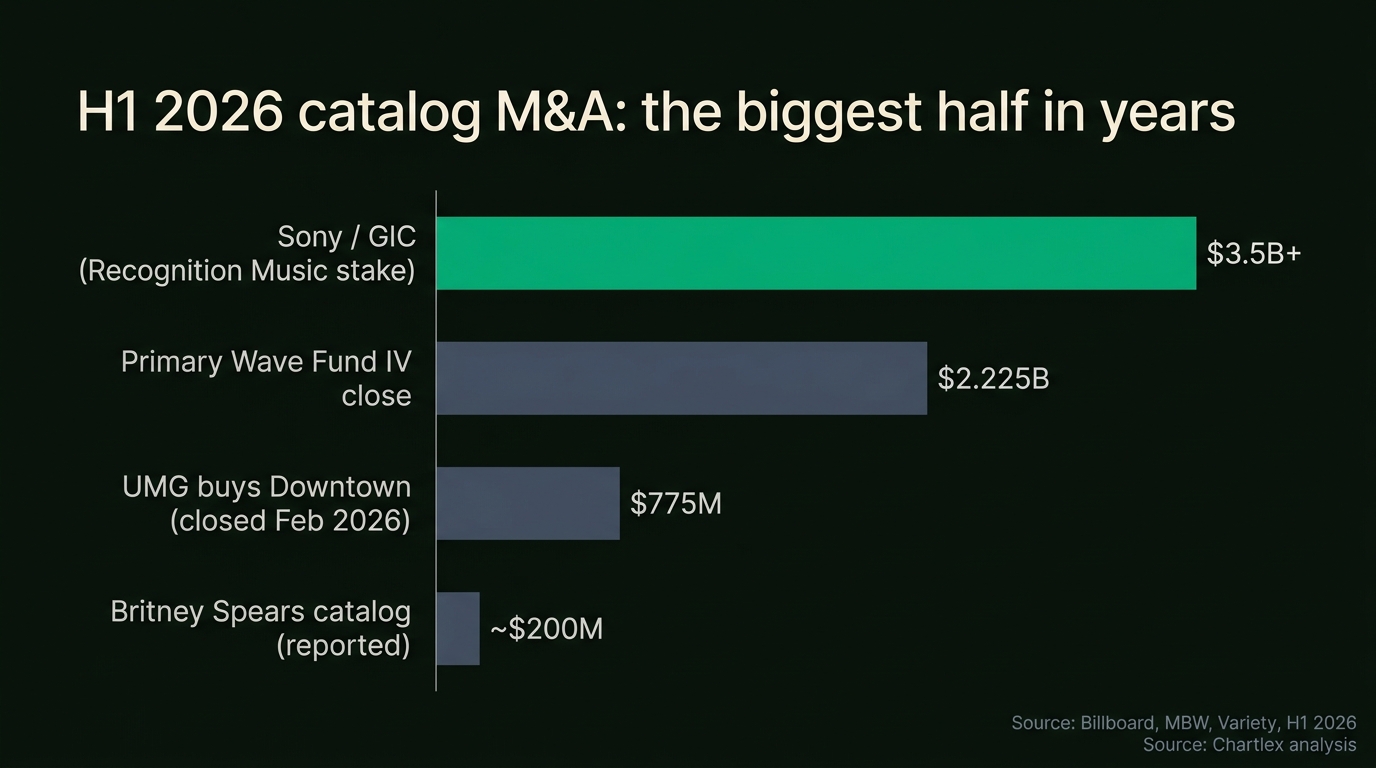
The deal market did not just recover in H1 2026, it produced the largest publishing transaction since the Hipgnosis buyout. Newest first:
| Date | Deal | Reported value | What it means |
|---|---|---|---|
| Early Jul 2026 | Primary Wave closes acquisition of Kobalt's publishing operation, catalog, and AMRA | Multi-billion (undisclosed); combined entity oversees $7B+ in assets | The largest indie publishing consolidation of the cycle (Digital Music News, Synchtank) |
| May 2026 | Sony Music Publishing + GIC acquire Recognition Music Group (the former Hipgnosis assets) from Blackstone | Reported $3.5B+ for ~45,000 songs | Blackstone exits, Sony consolidates the biggest catalog prize on the market (Hollywood Reporter, Billboard, MBW) |
| Late Apr 2026 | Primary Wave and Brookfield close Fund IV | $2.225B in commitments, above a $1.5B target | Largest closed-end music royalties fund ever raised (Billboard) |
| Apr 2026 | BMG and Concord confirm merger | Undisclosed | Two of the largest independents combine (Billboard) |
| Feb 2026 | Britney Spears sells her catalog to Primary Wave | Reported ~$200M | The half's marquee artist-level sale (Billboard) |
| Feb 20, 2026 | UMG's Virgin Music Group completes Downtown Music Holdings acquisition | $775M | Closed after EC approval with a Curve divestment condition (Variety, MBW) |
Multiples have stabilized rather than reflated: industry reporting through 2026 continues to put quality catalogs at roughly 12 to 18 times net publisher's share, down from the 2021 peak of 18 to 25 times. The running deal log, valuation math, and what any of this means for an artist who owns their masters live in our music catalog acquisitions tracker. Labels and agencies watching consolidation reshape distribution can also compare notes through Chartlex's partner program, which exists precisely because the mid-tier of the market keeps hollowing out.
Layoffs and Restructuring: A Rolling Correction, Not a Shock
H1 2026 produced no single megacut on the scale of Spotify's December 2023 round. What it produced instead was a steady drip. Spotify trimmed roughly 3 percent of its podcast group (about 15 roles at The Ringer and Spotify Studios) in March 2026 (Variety). UMG's Mercury Studios saw senior exits the same month, and Warner Music Canada cut at least 24 roles as part of the global restructuring (Billboard Canada).
The structural programs behind the drip are still live. Warner's $300 million cost plan, with $170 million from headcount, continues rolling through fiscal 2026 (Variety, Billboard), and UMG's redesign targets 250 million euros in savings. The company-by-company log, severance benchmarks, and sector hiring outlook are maintained in our music industry layoffs tracker.
The through-line: majors are trading headcount for catalog and technology spend. Warner cut staff costs in the same window it deployed catalog capital, and Spotify has said publicly it is not backfilling mid-level engineering roles as AI tooling absorbs routine work.
AI's Measurable Impact: Supply Floods, Demand Flatlines, Courts Move
H1 2026 was the half when AI's effect on music became quantifiable instead of speculative. The supply side is exploding. Deezer reported in April 2026 that 44 percent of new daily uploads were fully AI-generated, then crossed 50 percent by July, roughly 90,000 tracks per day at peak (Deezer Newsroom, TechCrunch). Apple Music's Oliver Schusser said in April 2026, on Billboard's On The Record podcast as reported by Music Ally, that more than 33 percent of new uploads to Apple Music are fully AI-generated.
The demand side refuses to follow. AI tracks account for just 1 to 3 percent of Deezer streams, and about 85 percent of those streams are flagged as fraudulent and demonetized (Deezer, July 2026). On Apple Music, AI tracks draw under 0.5 percent of listening time. The gap between AI supply and AI demand is the single most artist-relevant data point of the half, and we break the royalty math down fully in AI vs human listening time.
The legal layer moved too. On July 31, 2026, the Munich Regional Court ruled for GEMA against Suno, finding that training on GEMA's repertoire without a license infringed copyright and ordering damages and disclosure (Music Week, Variety). It is the first major European ruling on AI music training, and it landed while the US label cases sit on 2027 schedules. Full docket status is in our AI lawsuits tracker.
Commercially, AI acts crossed into the mainstream: Suno-built R&B artist Xania Monet signed a Hallwood Media deal reported at up to $3 million and charted on Billboard's Adult R&B Airplay chart, a first for an AI artist (Xinhua, Billboard reporting). Spotify's AI song credits, launched in beta April 16, 2026 via DistroKid's DDEX pipeline, began tagging disclosed AI usage in track credits.
Vinyl, CDs, and Live Music at Mid-Year
Physical had a plot twist. Luminate's midyear data shows US CD sales up 16 percent to 16.3 million units in H1 2026, growing faster than vinyl (up 2.4 percent) for the first time in over a decade, driven largely by K-pop fan-culture collecting. Vinyl's longer arc remains intact: the RIAA's 2025 year-end report logged a 19th consecutive year of vinyl growth, 46.8 million units shipped against 29.5 million CDs. The pressing-plant economics and indie-run implications are covered in our vinyl industry report.
Live music posted record totals with thinner per-show economics. Pollstar's mid-year analysis put Top 100 worldwide tour grosses at $3.16 billion, up 12.3 percent, on 26.3 million tickets, up 12.8 percent. But North American grosses were flat at $1.92 billion, average gross per show fell about 5 percent to $1.63 million, and stadium tours dropped from 18 at mid-year 2025 to 11. Bad Bunny led the chart with $225.2 million. Growth is coming from volume and international markets, not from pricier US stadium runs.
What H1 2026 Means for Independent Artists
Strip the earnings language away and four practical facts remain for independent artists.
Discovery is getting more competitive per stream, not less. Streams grew 9.8 percent while paid subscribers grew far more slowly, and tens of thousands of AI tracks enter the pool daily. According to Chartlex campaign data from 2,400+ campaigns, the tracks that keep earning algorithmic reach in this environment are the ones with strong save rates and completion rates, because those are the signals that separate a real audience from upload noise.
The AI flood is a filter, not a death sentence. Platforms are demonetizing fraudulent AI streams and tagging AI content, which concentrates royalty payouts on music that real listeners choose. Human engagement signals are becoming more valuable precisely because synthetic supply is worthless without them.
Consolidation raises the value of owned audiences. With BMG-Concord, Primary Wave-Kobalt, and the Recognition sale, fewer and larger rights-holders control more of the market. An independent artist's counterweight to that concentration is a direct audience and clean data. If you want to know what your streaming profile actually signals before you spend anything, a free Chartlex audit breaks down where your listeners come from and which signals are weak.
Price increases are buying the industry time. Streaming 2.0 pricing carried H1 growth, and that lever has limits. Artists who convert listeners into savers and followers now, while reach is still cheap relative to where this market is heading, compound the advantage. That is the strategy problem Chartlex plans are built around, and the revenue math per platform is easy to sanity-check with the Spotify royalty calculator.
Free Spotify Audit
See exactly where your Spotify profile is leaking growth.
One audit finds an average of 4 growth blockers per artist profile.
Pro Growth Plan
$599/mo
Serious about building a music business? Consistent algorithmic momentum puts you on Spotify's radar.
Verified in Spotify for Artists · Geo-targeted · Cancel anytime
For the prediction-side view of how the year plays out for independents specifically, see the 2026 state of the indie music industry.
Frequently Asked Questions
How big is the music industry in 2026?
Global recorded music revenue reached $31.7 billion in 2025, up 6.4 percent, per IFPI's Global Music Report 2026. H1 2026 earnings suggest continued high-single to low-double-digit growth: UMG revenue rose 13.3 percent and Warner rose 10 percent in the April-June quarter. Full-year 2026 totals publish in March 2027.
Is streaming still growing in 2026?
Yes, but the growth mix changed. Global on-demand audio streams rose 9.8 percent in H1 2026 per Luminate, while subscriber growth slowed and price increases carried more of the revenue gain. Spotify added 7 million Premium subscribers in Q2 2026 to reach 300 million, with most stream growth coming from outside the US.
What share of music is AI-generated in 2026?
More than 50 percent of Deezer's daily uploads and over 33 percent of Apple Music's new uploads are fully AI-generated as of mid-2026, per both platforms' own disclosures. Listening has not followed: AI tracks draw 1 to 3 percent of Deezer streams and under 0.5 percent of Apple Music listening time.
What was the biggest music industry deal of H1 2026?
Sony Music Publishing, backed by Singapore's sovereign fund GIC, agreed to acquire Recognition Music Group, the former Hipgnosis catalog of roughly 45,000 songs, from Blackstone for a reported $3.5 billion-plus in May 2026. Primary Wave's Kobalt publishing acquisition and the BMG-Concord merger were the other landmark H1 transactions.
Are music industry layoffs still happening in 2026?
Yes, as a rolling correction rather than mass cuts. H1 2026 saw Spotify trim about 3 percent of its podcast group, senior exits at UMG's Mercury Studios, and at least 24 cuts at Warner Music Canada, while Warner's $300 million cost program and UMG's 250 million euro savings plan continued through the half.
Is vinyl still growing in 2026?
Barely, and CDs are the surprise. Luminate's H1 2026 data shows US vinyl unit sales up just 2.4 percent while CDs grew 16 percent to 16.3 million units, the first time in over a decade CDs outgrew vinyl, driven by K-pop collecting. Vinyl still leads physical revenue by a wide margin per the RIAA.
What to Watch in H2 2026
The half's verdict is simple: record revenue, slowing subscriber engines, consolidating ownership, and an AI supply glut that listeners keep ignoring. The industry is getting bigger and narrower at the same time, and the artists who thrive are the ones treating engagement signals, owned audiences, and clean data as their core assets. Watch for the RIAA mid-year report in September, Spotify's Q3 numbers in late October, and the first revenue disclosures from the licensed AI platforms rolling out through the fall.
If you want your own H2 plan grounded in the same kind of data this report runs on, get your free Chartlex audit and see exactly where your catalog stands before the next quarter's numbers drop.
Free Weekly Playbook
One actionable insight, every Tuesday.
Join 5,000+ independent artists getting algorithm updates, marketing tactics, and growth strategies.
No spam. Unsubscribe anytime.
Get a business health check for your music career.
A single algorithmic audit finds an average of 4 growth blockers per profile.
Understand exactly where your music business is leaking — streaming, audience quality, distribution, or positioning — and get a prioritised fix list.
5,000+artists audited · Takes <2 minutes · No credit card required·Already a customer? Open Dashboard →
Campaign Dashboard
Turn Knowledge Into Action
Track your streams, monitor algorithmic triggers, and see growth projections in real time. The Campaign Dashboard puts everything you just read into practice.
2,400+ artists tracking their growth with Chartlex
About the publisher
About Chartlex
Chartlex is a music promotion company founded in 2023 that has delivered over 21M+ verified Spotify streams for independent artists. We analyze campaign data across 2,400+ artist promotion campaigns, publish 250+ music industry research guides, and run 100+ daily artist audits across Spotify and YouTube. Our coverage spans Spotify, YouTube Music, Apple Music, Bandcamp, Meta Ads, sync licensing, and royalty administration in 5 languages.
- Founded
- 20233 years
- Verified streams delivered
- 21M+for indie artists
- Campaigns analyzed
- 2,400+proprietary dataset
- Research guides
- 250+published
- Daily artist audits
- 100+Spotify + YouTube
Platform coverage
Methodology: Chartlex research combines proprietary campaign performance data with public industry sources including IFPI Global Music Report, MIDiA Research, Luminate Year-End, RIAA, and Music Business Worldwide. All findings are refreshed quarterly. Last verified: 2026-09-22.
Keep reading
12 verified Q1 2026 music industry numbers: streaming growth, Spotify ARPU, vinyl, sync, AI lawsuits, M&A, layoffs, indie share, and chart concentration.
Daniel Brooks
How to start a record label in 2026: LLC setup from $35, the 50/50 indie deal standard, label distribution options, and a realistic startup budget.
Daniel Brooks
Tracker of every AI music licensing deal of 2025-2026: UMG and Udio, Warner and Suno, KLAY's three-major sweep, Spotify's AI pact, and how indies get paid.
Daniel Brooks